Due Diligence
Part of Manufacturing and production oversight
Reviewing an unexpected production delay
Turn an unexpected factory delay into a verified cause, recovery choice and updated shipping decision.
When a supplier reports a delay, separate what is known from what is promised.
“We will catch up next week” is not a recovery plan if the missing input, remaining quantity and inspection time are unknown.
Establish the current position
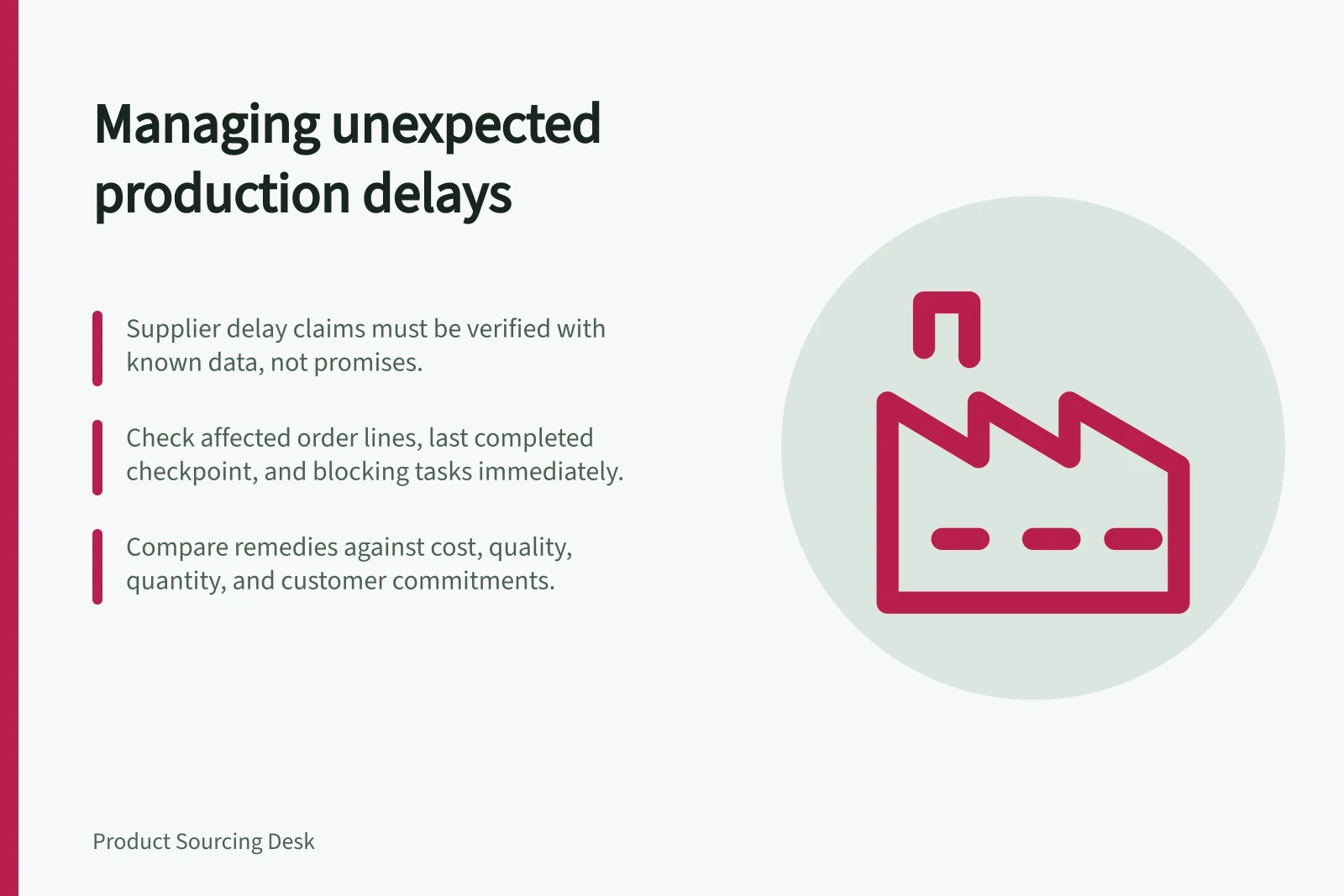
Ask which order lines and variants are affected, the last completed checkpoint, units accepted so far and the blocking task.
Request a dated forecast for the next verifiable milestone, then compare it with the original ship-ready date.
Check whether the cause is a one-off interruption or a continuing constraint, such as an unavailable component.
For a hypothetical order waiting on replacement packaging, the finished product may be ready but not shippable.
This differs from a production-line fault: alternative packaging might need a protection test and buyer approval, while a line fault may require rework capacity and a new inspection slot.
Supplier Delay Metrics to Track
- Original Ship-Ready Date
- To be confirmed from contract
- Next Verifiable Milestone
- Dated forecast from supplier
- Units Accepted So Far
- To be confirmed from production log
- Blocking Task Identified
- Yes/No – to be confirmed
Evaluate options without losing quality
Compare each proposed remedy against cost, quality, quantity and customer commitments.
Overtime may help only if the constrained operation can actually run longer.
Split shipment can protect an urgent allocation but creates additional freight and receiving work.
Substituting an input requires its own specification approval.
Request evidence for the revised dates rather than accepting an optimistic percentage.
Write down the chosen plan, owner, next checkpoint and a date at which you will reassess.
Keep the original commitment visible beside the forecast and record any agreed contractual variation.
Tell affected internal teams which promise is at risk and when they will receive the next confirmed update.