Due Diligence
Part of Responsible and resilient sourcing
Asking for evidence behind supplier sustainability claims
Define a supplier sustainability claim, request records covering the actual goods and decide what wording the evidence supports.
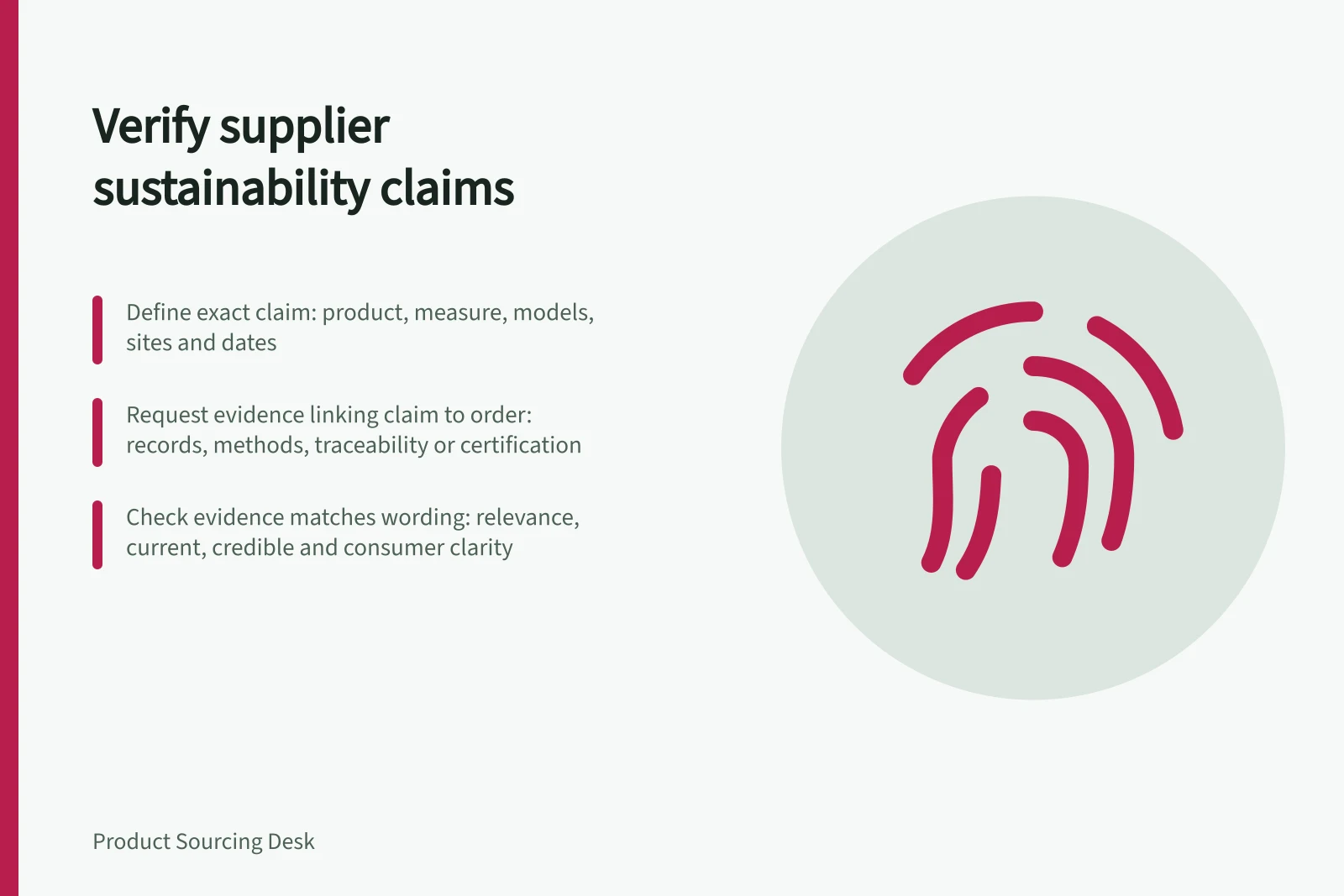
Before approving customer-facing wording, define the exact claim: the product or component, the measure, the models and variants, the sites and dates covered, and any qualifications. Then request evidence that connects that claim to the goods you intend to buy.
The Australian Consumer Law (ACL) prohibits misleading or deceptive conduct under section 18 and false representations, including about goods’ composition or benefits, under section 29. The ACCC’s environmental claims guidance sets out its view of good practice under the ACL, and the ACCC can investigate suspected breaches and may take compliance or enforcement action.
Key regulatory guidance on environmental claims in Australia
- Regulator
- Australian Competition and Consumer Commission (ACCC)
- Supporting framework
- Recycled content traceability guidelines (DCCEEW)
Turn the claim into a question
Broad terms such as sustainable and eco friendly can suggest more than the supplier can support. Turn the wording into a checkable statement, such as recycled content in a named component, a measured change at one site or progress towards a stated target.
Record the claim’s subject, measure, coverage and qualifications. Coverage should identify relevant models, variants, sites and dates; for example, a recycled-content claim about a pouch lining should specify the lining and production version.
Ask the supplier: “For [exact claim] on [product or component], please provide the evidence supporting this wording. Include the method and underlying records, the models or variants, sites and dates covered, any qualifications, and the record linking the evidence to units in our order.” For third-party certification, request the certificate and its scope.
Ask for records that connect to the order
Depending on the claim, request purchase and production records, the calculation method, a complete test report, traceability information or reputable third-party certification. The ACCC identifies reliable scientific reports, transparent supply chain information, reputable third-party certification and other forms of evidence as ways to substantiate environmental claims.
For a proposed recycled-content claim about packaging, ask for the calculation method and traceability information linking the material input to the units in your order. Ask which purchase or production records support that link; a company policy may provide context, but it does not establish a claim about a finished product.
Check who created each record, when and by what method. If the supplier relies on a certificate, ask who issued it and check its status and scope with the issuer when the buying decision depends on it; a certificate naming a company or facility may not cover the product or period at issue.
Decide what the evidence supports
Check whether the evidence is relevant, current and credible, and whether its subject, measure, coverage and qualifications match the proposed wording. For third-party material, assess independently whether it is sufficient; do not assume that a certificate supports claims beyond its stated scope.
Compare the wording with what an ordinary consumer is likely to understand. The ACCC advises that environmental claims should be clear and accurate and should not mislead; consider the whole presentation, including prominent packaging text and images, because a correct detail can still mislead when broader context is omitted.
Keep a claim record with the proposed wording, documents reviewed, coverage, any gap and the decision owner. Mark the result supported for the stated scope, wording needs revision or hold pending evidence; missing information is not a favourable finding.
Revise wording that reaches beyond the evidence to describe only the supported subject, measure and coverage, with relevant qualifications. Recheck the record if a material, factory, production method or supplier statement changes, because evidence for an earlier version does not automatically cover a new one.