Supplier Shortlists
Part of Responsible and resilient sourcing
Comparing supplier alternatives before an emergency
Compare contingency routes against the same disruption, product requirement, delivery need and activation conditions.
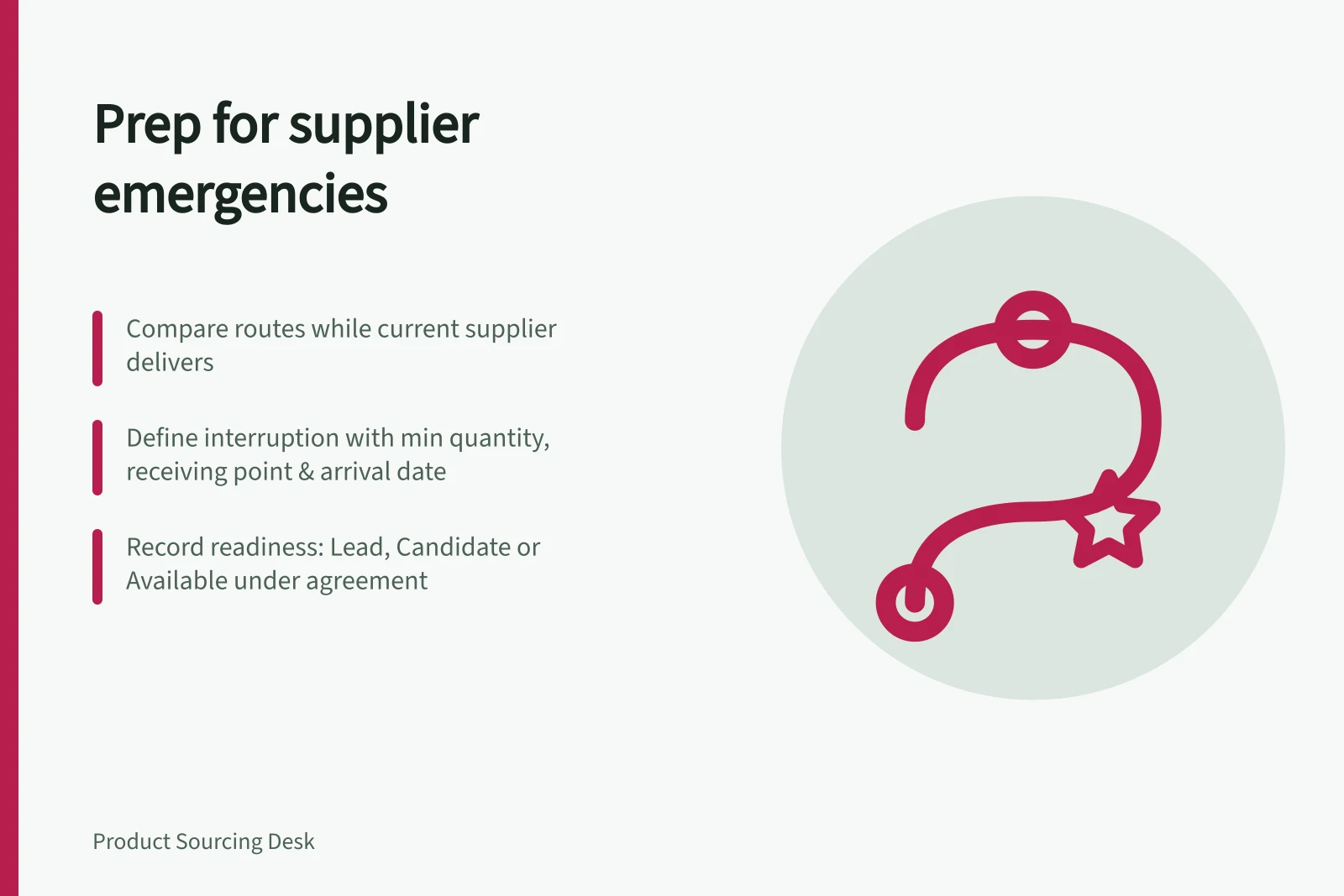
Compare alternative routes while your current supplier is still delivering. Give candidates the same product requirement and disruption scenario, then record what each can support, what needs approval and how an order could be placed. An indicative price alone does not make a contingency route usable.
Define the interruption
Start with the dependency you need an alternative to avoid: a closed site, unavailable material, lost capacity for one variant or another defined failure. State the minimum usable quantity, Australian receiving point and latest useful arrival date. A different seller using the failed input does not solve that scenario.
Separate fixed product requirements from features that could change. A new material or production route may affect fit, customer-facing descriptions and earlier safety evidence. For consumer goods supplied in Australia, assess the requirements for the version you would actually sell.
Compare routes on the same basis
Send each candidate the current specification, contingency quantity and timing question. Ask for the contracting seller, site doing critical work, proposed inputs, deviations, minimum order, lead-time starting event and delivery point. Record what it can evidence now and what requires a sample, trial or later confirmation.
Decision question / Useful answer
- Does it avoid the failed dependency?
- Identified critical site and input, or a marked information gap
- Can it supply the required version?
- Stated deviations and evidence for that version
- Could goods arrive in time?
- Production and delivery assumptions with open steps shown
- Is the commitment workable?
- Quantity, payment timing and buyer tasks
- How would it be activated?
- Contact, order steps, approvals and any agreed availability terms
Compare the work left with the buyer, as well as the goods price. An unquoted charge or unchecked product feature remains open; it is neither zero nor passed.
Supplier Contingency Route Evaluation Criteria
- Decision question
- Does it avoid the failed dependency?
- Useful answer
- Identified critical site and input, or a marked information gap
- Decision question
- Can it supply the required version?
- Useful answer
- Stated deviations and evidence for that version
- Decision question
- Could goods arrive in time?
- Useful answer
- Production and delivery assumptions with open steps shown
- Decision question
- Is the commitment workable?
- Useful answer
- Quantity, payment timing and buyer tasks
- Decision question
- How would it be activated?
- Useful answer
- Contact, order steps, approvals and any agreed availability terms
Record readiness
Use bounded labels for the stated scenario. Lead means a supplier has responded. Candidate for assessment means the product and route are described but material checks remain.
Available under an agreed arrangement means written terms address the availability, quantity and activation steps you plan to rely on. Before ordering, confirm current capacity and price.
A later project may assess a preferred candidate through a sample or pilot order.
Record a preferred route and fallback for each scenario, with reasons, open conditions, an activation owner and a review date.
Supplier Readiness Levels for Contingency Planning
- LeadA supplier has responded to the contingency request.
- Candidate for assessmentThe product and route are described but material checks remain pending.
- Available under an agreed arrangementWritten terms address availability, quantity and activation steps; confirm current capacity and price before ordering.
Key Elements to Record for Supplier Contingency Planning
- Preferred route for each scenarioWith documented reasons and review date
- Fallback route for each scenarioWith documented reasons and review date
- Open conditionsUnconfirmed pricing, material availability, or compliance status
- Activation ownerPerson responsible for triggering the contingency plan
- Review dateWhen the readiness status will be reassessed