Supplier Shortlists
Part of Finding and shortlisting suppliers
Comparing manufacturers with trading companies
Compare manufacturers and trading companies by production roles, changes, included work and responsibility for defects.
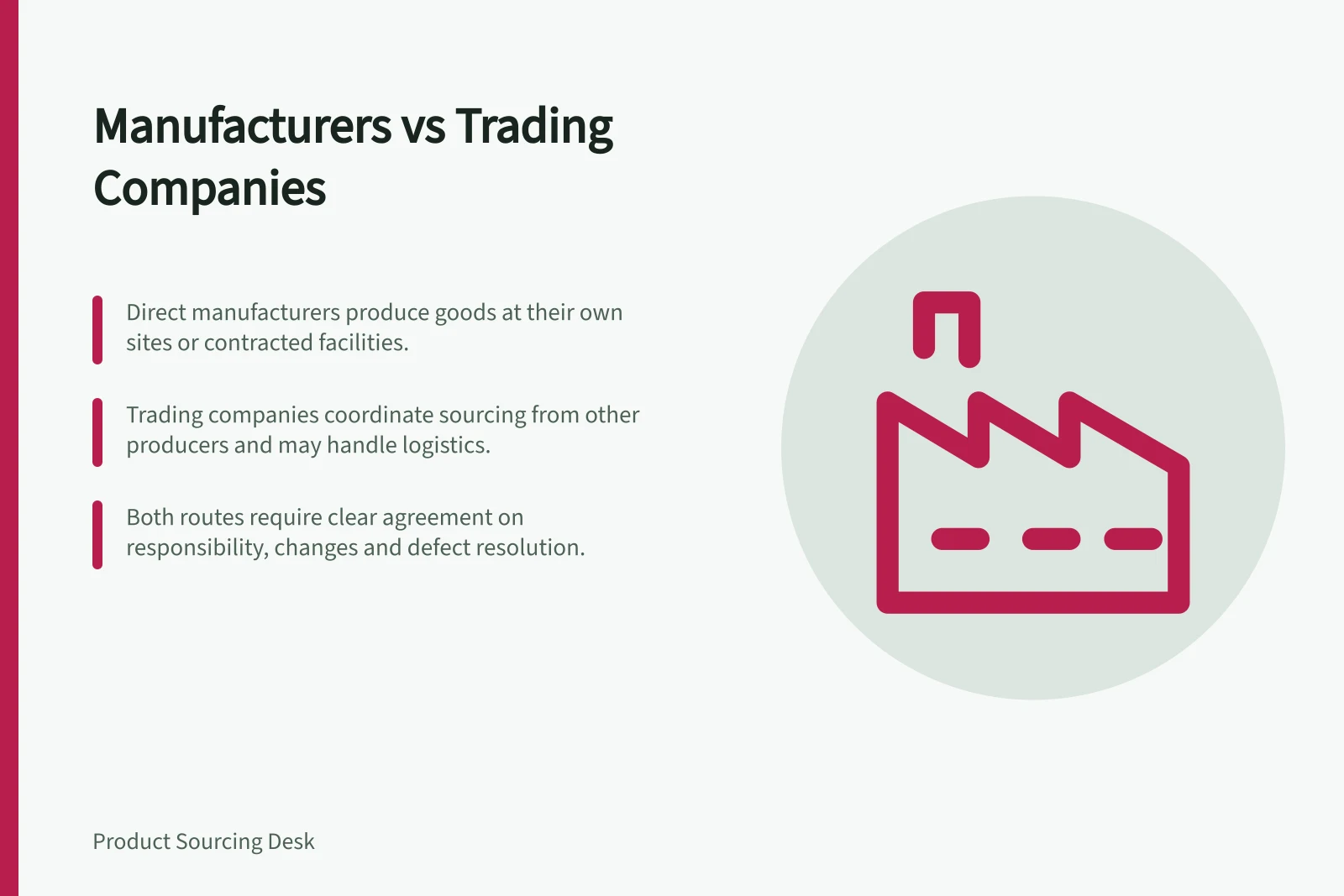
Compare manufacturers and trading companies by what each will do for your order, how product questions reach the producer and who is responsible for the goods you buy. Buying directly is not automatically cheaper or safer; the proposed arrangement matters more than the label.
Here, a manufacturer performs the relevant production work. A trading company sells or coordinates goods made by another business. One business may combine these roles, so ask what it will actually do for the proposed product.
Compare offers for the same item
Give candidates the same brief, variants, quantity range and delivery need. Ask them to identify deviations. An existing catalogue item and a customised version are different offers even if their descriptions look similar.
| Question | Direct manufacturer | Trading company |
|---|---|---|
| Who makes the goods? | Identify the relevant production site and any work done elsewhere. | Identify the proposed producer and whether it may change. |
| Who handles changes? | Identify who can approve a production change and when you must approve it. | Ask how your decision reaches the producer and how approval is recorded. |
| What work is included? | Check the offered design, production, packing and delivery tasks. | Check the offered sourcing, coordination, consolidation and delivery tasks. |
| Who deals with defects? | Record the seller’s proposed remedy and available production evidence. | Record the seller’s remedy and how it will obtain action from the producer. |
These are questions, not guaranteed differences. A manufacturer may outsource a component, and a trading company may provide valuable coordination.
Direct manufacturer vs trading company: Key differences in responsibilities
- Who makes the goods?Identify the relevant production site and any work done elsewhere.
- Who handles changes?Identify who can approve a production change and when you must approve it.
- What work is included?Check the offered design, production, packing and delivery tasks.
- Who deals with defects?Record the seller’s proposed remedy and available production evidence.
Match the route to the order
Direct production discussion may help when a product needs technical changes or a critical process must be understood. Ask who can answer questions about materials, tooling and process limits, and who can act on the agreed specification.
A trading company may help coordinate items from several producers. Establish whether it will sell you the finished goods or act as an agent arranging a purchase from someone else. If it cannot identify the producer yet, record when and how that information will become available.
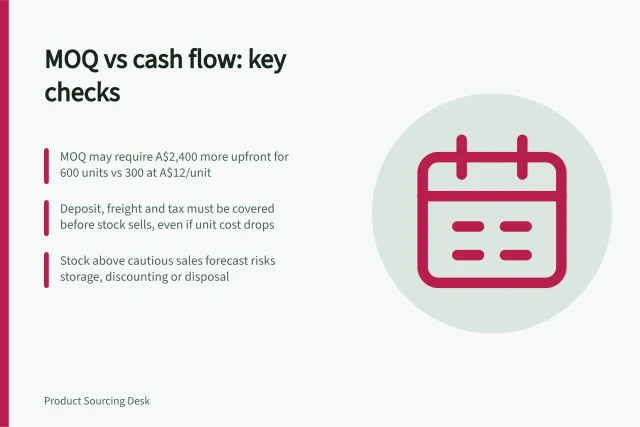
Compare minimum order, indicative lead time, payment stages, delivery point and tasks left to your business. Unit price alone does not show whether inspection, freight or correction work is included. Detailed quotations can follow once the proposed product version and roles are clear.
If your business will supply consumer products in Australia, it remains responsible for their safety whichever route it chooses. Ask which party will provide production details and evidence relevant to the actual goods; the supply arrangement itself does not establish compliance.
Choose a route with clear responsibilities, a workable path for product questions and a documented response to defects. Resolve any unclear critical role before treating the offer as comparable. Verify company and factory claims separately before commitment.
Pros and cons of buying from a direct manufacturer vs a trading company
- Direct manufacturer – ProsGreater control over production process; clearer accountability for quality and safety; direct access to technical expertise on materials, tooling and process limits.
- Direct manufacturer – ConsMay require higher minimum order quantities; less flexibility in sourcing components from multiple suppliers; limited support for logistics and coordination.
- Trading company – ProsCan coordinate multiple producers; may offer lower MOQs; provides end-to-end logistics and consolidation; useful for complex or customised products.
- Trading company – ConsLess direct oversight of production; potential for unclear responsibility if producer changes; risk of delays if coordination breaks down.