Supplier Shortlists
Part of Sourcing costs and landed cost
Comparing minimum order quantities with cash needs
Assess supplier MOQs against deposits, import cash outlays, likely sales and the cost of holding extra stock.
Compare a supplier's minimum order quantity (MOQ) with the cash due before the stock produces sales, and with its unit price. For each offer, map the quantity, deposits, later payments, arrival date and likely sales. A cheaper unit can still leave too little cash for freight, tax, storage or normal operations.
Turn the MOQ into an order commitment
Confirm whether the minimum applies per product, colour, size, production run or whole purchase order. Ask whether deliveries may be split and when each batch must be paid for. A price break at a higher quantity is a different commitment from the smallest order the supplier accepts.
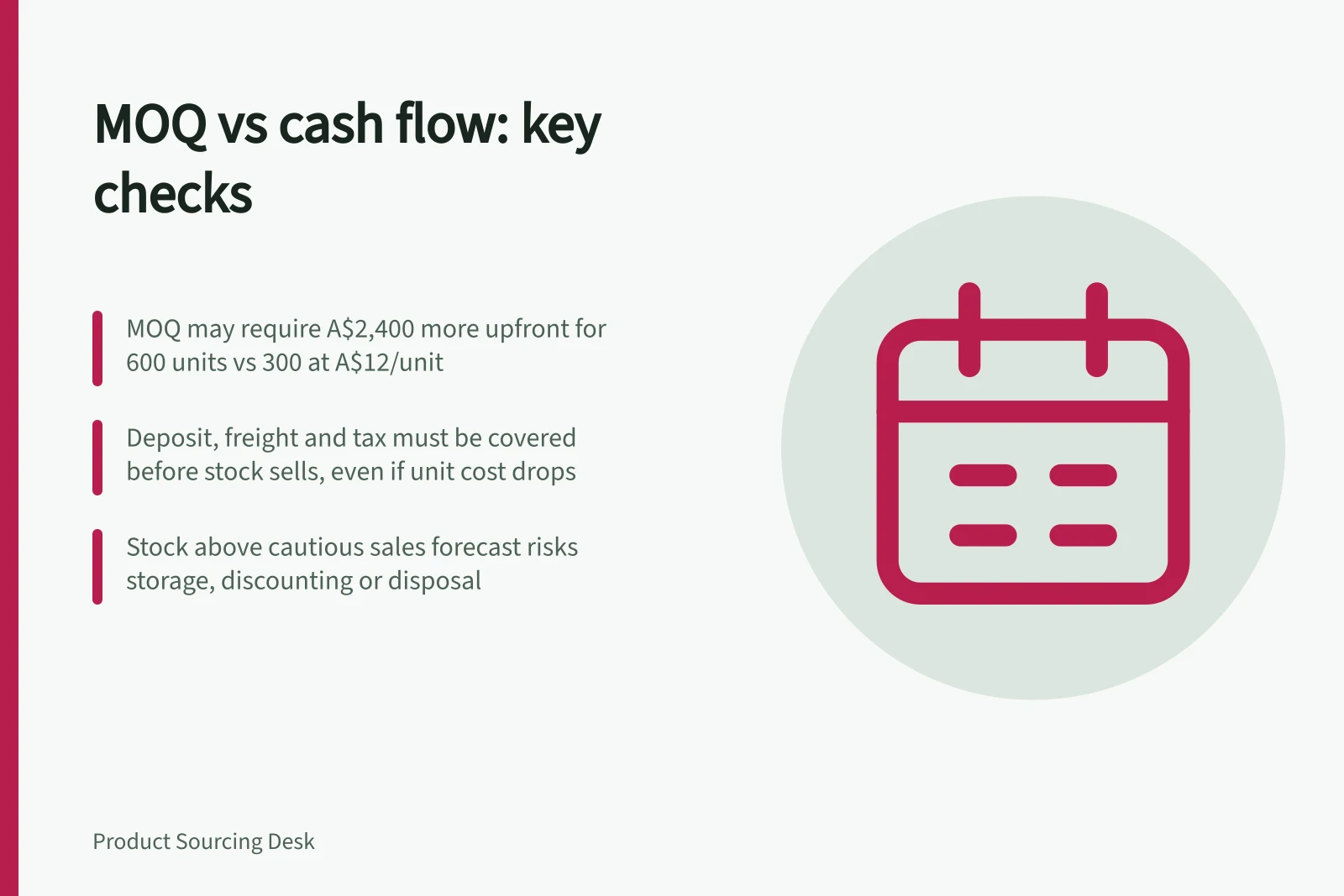
Estimate what you can sell before realistic replenishment. Record the basis for that estimate and compare a cautious case with your expected case. Stock above the cautious case may require longer storage, discounting or disposal. Assess those possibilities for the product rather than assuming every unit sells at the planned price.
Compare cash by date
Point in the order / Cash to identify
- Before production
- Deposit, samples and any setup or tooling fee.
- Before dispatch
- Balance due, inspection and agreed correction work.
- At import or receipt
- Freight, applicable import charges, local delivery and receiving costs.
- While stock sells
- Storage, financing cost if relevant, and routine business payments.
Include any known tax-related cash outlays in the forecast. A later supplier payment may ease a cash gap without reducing the purchase quantity or goods cost.
Cash Outlays by Order Stage
- Before Production
- Deposit, samples, setup/tooling fees
- Before Dispatch
- Balance due, inspection, correction work
- At Import or Receipt
- Freight, import charges, local delivery, receiving costs
- While Stock Sells
- Storage, financing cost (if applicable), routine business payments
Test the price break
Consider hypothetical offers of 300 units at A$12 each and 600 units at A$10 each, with all other terms held equal for the example. Goods cost A$3,600 for the smaller order and A$6,000 for the larger one.
The second offer is A$2 cheaper per unit but requires A$2,400 more for goods. If only 300 units sell in the planning period, 300 units from the larger order remain, representing A$3,000 of purchase cost tied to stock. Freight, storage and tax could alter the comparison; they are not estimated here.
Check whether expected sales, storage capacity and available cash support the larger commitment. If a quote proposes staged deliveries, establish whether that changes the total quantity you are obliged to buy or only the dates when stock and payments move.
Choose using both the expected cost per usable unit and the lowest forecast cash balance before the stock sells. Keep forecast demand distinct from a binding purchase order. Update the comparison when actual sales improve your estimate.