Landed Cost
Part of Sourcing costs and landed cost
Separating recurring costs from tooling and setup fees
Compare per-unit, per-run and one-time sourcing charges, including first-order cash, repeat-order cost and tooling control.
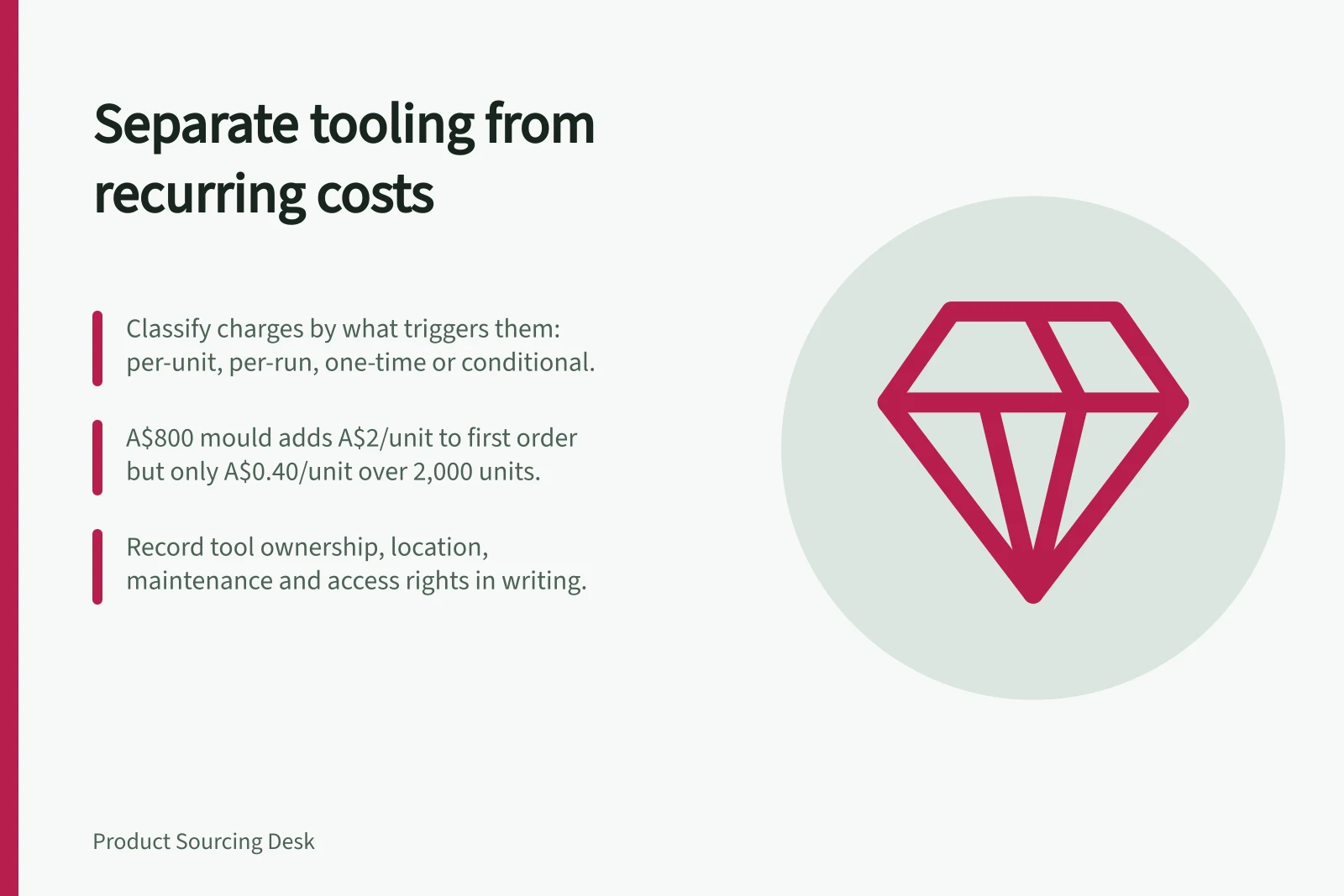
Classify each charge by what triggers it. A per-unit fee, a setup fee for each production run and an upfront mould payment affect first-order cash and repeat-order cost differently. Show them separately before comparing suppliers.
Classify each charge
| Charge type | Question to settle |
|---|---|
| Per unit | Is it included in the unit price for every variant and repeat order? |
| Per order or run | Does setup or a minimum service fee recur whenever production starts? |
| One time | Is a mould, die, artwork preparation or development fee payable once for the approved design? |
| Conditional | Would a design change, repair, new colour or volume change trigger another payment? |
A label is not a supplier term. A 'setup' fee might recur with every run. A 'free' tool might be reflected in the unit price or become payable if ordering stops. Obtain the trigger, amount, payment date and repeat-order treatment in writing.
Steps to Accurately Compare Supplier Offers with Tooling and Setup Fees
- Identify each charge typePer unit, per order/run, one time, conditional
- Determine the trigger for each chargeWhat causes payment? (e.g., design change, new run)
- Clarify payment date and recurrenceIs it upfront, deferred, or recurring?
- Document ownership and control of physical toolsRecord who holds, maintains, and can access the tool
- Compare cumulative costs at credible volumeUse same product, volume, delivery terms across offers
Compare first and repeat orders
Use the same product, volume and delivery boundary for each offer. The first-order view covers all payments needed now: goods, tooling, setup and delivery-related costs. The repeat-order view covers charges that arise again under the proposed terms. Keep the upfront payment visible in the cash plan and any longer-term comparison.
For a hypothetical A$800 mould and a first order of 400 units, assigning the payment to that order adds A$2 per unit to its planning figure.
If 2,000 units are eventually made with the mould, the arithmetic share across that volume is A$0.40 per unit. The business still needs A$800 when due, and future orders may never occur. Neither calculation determines accounting or customs treatment.
A supplier with no separate tooling fee may charge a higher unit price. With two actual offers, compare cumulative payments at a credible volume. Check whether a lower repeat price repays any upfront difference, and include any recurring setup charge.
First-order vs Repeat-order Cost Breakdown for a Hypothetical Mould
- Charge Type
- One-time tooling fee (mould)
- Trigger
- Once, upon approval of design
- First-order cost impact (400 units)
- A$2.00 per unit
- Payment timing
- Upfront, before production begins
Record control of a physical tool
Ask who owns the tool, where it will be kept, who maintains it, whether it may be used for other customers and how you could obtain it if production ends. Record any practical or agreed limits. Paying an invoice labelled 'tooling' does not by itself establish ownership or access.
Keep the commercial fee comparison separate from customs valuation. If a tooling arrangement may affect the value declared for imported goods, have the actual arrangement assessed before declaring the goods.
The comparison record should show each fee's amount, trigger, payment date, recurrence and covered product version, along with the agreed position on tool control. Update it if a design change could cause a new charge.
Key Questions to Confirm Tooling and Setup Fee Terms
- Who owns the tool?To be confirmed in writing with supplier
- Where will the tool be stored?To be specified (e.g., supplier’s facility or client site)
- Who maintains the tool?Supplier or buyer – must be agreed
- Can the tool be used for other customers?Must be clarified – exclusive use may affect costs
- How can I retrieve the tool if production ends?Agreed terms required – e.g., return or transfer