Landed Cost
Sourcing costs and landed cost
Compare supplier offers by the cost of usable stock in Australia, minimum-order cash needs, import charges and one-off fees.
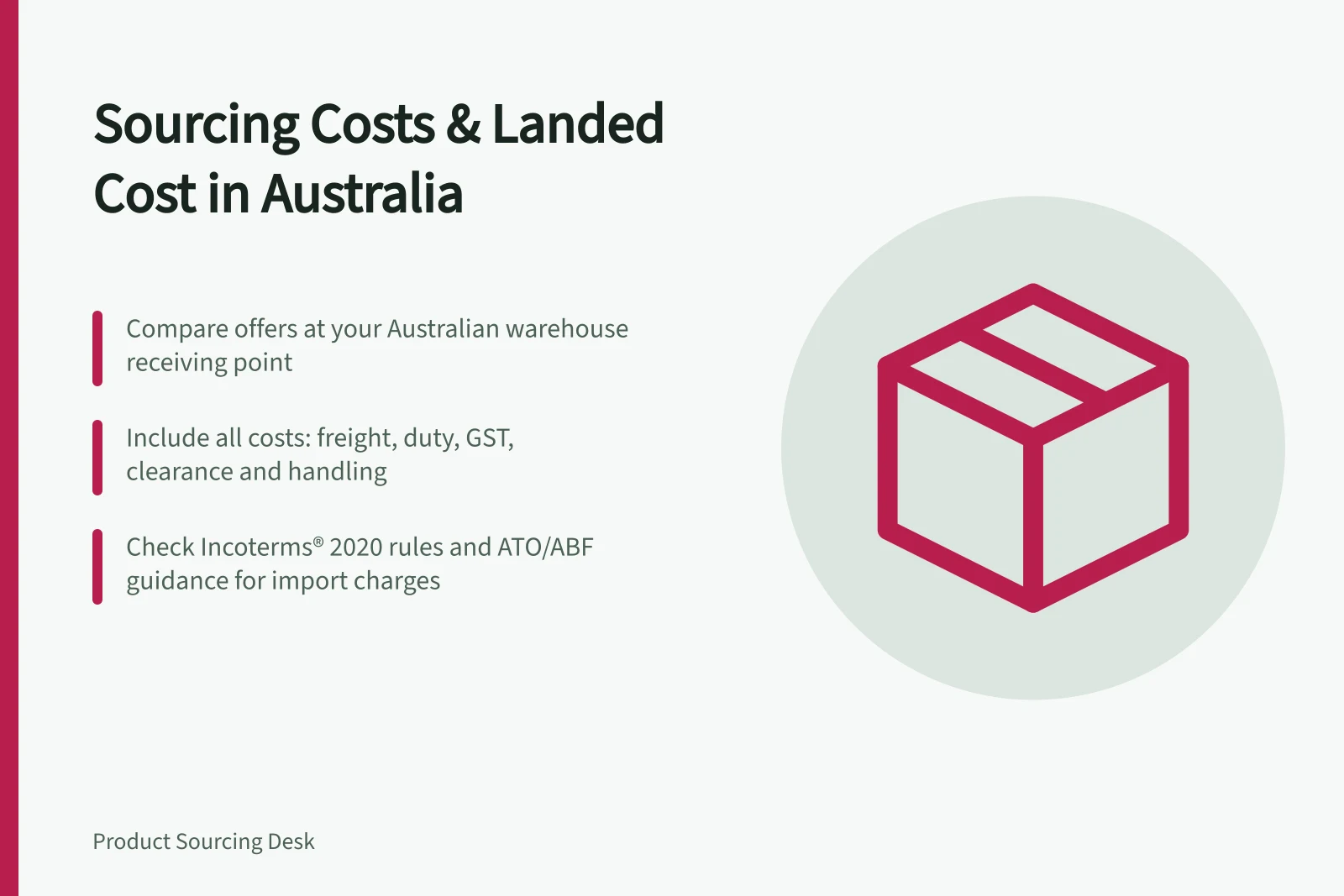
Compare sourcing offers at the point where stock is ready to use or sell, such as accepted goods at your Australian warehouse. Record the cost of getting it there, the quantity you must buy and when cash is due. Keep GST payments visible separately while confirming their treatment for your business.
Set one comparison point
Ask each supplier what its price covers up to your chosen receiving point. One offer may include delivery; another may end when goods leave the factory. Compare the same product specification and order quantity, and count each included charge once.
For an overseas order, record the agreed Incoterms® 2020 rule and named place. Check the actual quote for included services. Confirm any remaining freight, insurance, clearance, handling and delivery costs with the providers.
Supplier Offer Comparison: Sourcing vs Landed Cost
- Incoterms® 2020 Rule
- e.g., FOB Sydney, CIF Melbourne, DDP Brisbane
- Delivery Point
- Your Australian warehouse or receiving facility
- Freight Included?
- Yes/No – confirm with supplier
- Insurance Included?
- Yes/No – check policy terms
- Customs Clearance Included?
- Yes/No – verify scope
Build the order cost in layers
| Layer | What to check |
|---|---|
| Goods | Unit price, variants, packaging included in that price and quantity breaks. |
| Receiving the stock | Freight, insurance where relevant, clearance, handling, inspection and delivery to the comparison point. |
| Import charges | Duty and declaration-related charges where applicable. Show import GST separately as a cash item pending tax assessment. |
| Order-specific extras | Samples, tooling, setup, artwork or testing, with their payment dates. |
Do not assume duty from a supplier's general estimate. Check the tariff treatment, any applicable concession and the declaration details for the actual goods. Check current Australian Border Force guidance for charges that may apply to your declaration, and obtain a current shipment estimate.
The Import Processing Charge is a named Australian import charge; check with the Australian Border Force whether it applies to your Import Declaration and what the current charge is. A customs broker can prepare and lodge import declarations, so include its quoted fee if you use one.
The general Australian GST rate is 10%, but that figure alone does not establish the GST payable on an import. Keep import GST separate as a cash item and confirm its treatment for your business using Australian Border Force and ATO guidance.
Biosecurity requirements may affect clearance. If they apply, ask whether they create an additional charge and confirm any amount with the relevant provider or authority, including DAFF where relevant.
Record the source of each estimate. Mark an unquoted freight leg or unresolved duty treatment open rather than entering zero.
Building Landed Cost in Layers (Australian Import Context)
- Layer 1: GoodsUnit price, packaging, quantity breaks – include variant costs
- Layer 2: Receiving the StockFreight, insurance, customs clearance, handling, inspection, delivery to warehouse
- Layer 3: Import ChargesDuty (check tariff classification), Import Processing Charge (IPC), GST on import
- Layer 4: Order-Specific ExtrasSamples, tooling, artwork, testing – note payment timing
Key Australian Import Costs and Rates
- Import Processing Charge (IPC)
- Varies by declaration type; check ABF guidance
- Tariff Classification
- Use current Australian tariff schedule
- Biosecurity Fees (if applicable)
- Check DAFF or provider for additional charges
Compare unit cost and cash separately
Divide the costs assigned to the order by the usable units you expect to receive. State how rejected, replacement or short-shipped units are treated; dividing by units ordered can understate cost per usable unit. Separately, total the cash due before sales can fund the order, including deposits, freight and taxes due at clearance where applicable.
A lower unit price may require an order that uses more cash and storage. Compare the minimum order with a cautious estimate of what you can sell before replenishment. Treat the demand estimate as a forecast, not a supplier-quoted fact.
Keep one-off fees visible. A mould paid for with the first order affects today's cash requirement even if later orders may use it. Compare first-order and repeat-order costs; do not rely on hoped-for future volume to fund the initial payment.
Reconcile after delivery
Keep each offer's product version, quantity, delivery point, included charges, open estimates, cost per usable unit and payment dates in one record. After receipt, replace estimates with invoices and the accepted unit count. Note whether any difference came from freight scope, quantity, duty assessment or correction work.
Pre-Delivery Landed Cost Verification Checklist
- Confirm product version matches deliveryMatch against purchase order
- Verify delivered units vs expectedNote rejected, short-shipped or replacement units
- Replace estimates with actual invoicesInclude freight, duty, IPC, GST
- Reconcile cost per usable unitAdjust if initial estimate was based on ordered units
- Document differencesFreight scope, duty assessment, correction work
In this guide
- Calculating landed cost beyond the unit priceBuild an Australian landed-cost worksheet, avoid double counting and calculate cost per usable unit with tax assumptions kept clear.
- Comparing minimum order quantities with cash needsAssess supplier MOQs against deposits, import cash outlays, likely sales and the cost of holding extra stock.
- Separating recurring costs from tooling and setup feesCompare per-unit, per-run and one-time sourcing charges, including first-order cash, repeat-order cost and tooling control.