Supplier Shortlists
Product compliance sourcing checks
Identify Australian product requirements, match supplier evidence to the goods ordered and resolve compliance gaps before supply.
Before ordering a product for supply in Australia, identify the requirements for the finished item. Check that the supplier's evidence covers the version you will receive. Record unresolved questions and obtain qualified advice before relying on an uncertain compliance claim. A certificate or pre-shipment inspection alone cannot settle every product safety question.
Identify the applicable requirements
Describe the product's intended use, users, materials, components, variants and sales claims. Include accessories and packaging where they affect how it is supplied. A catalogue category may be too broad to establish which rules apply.
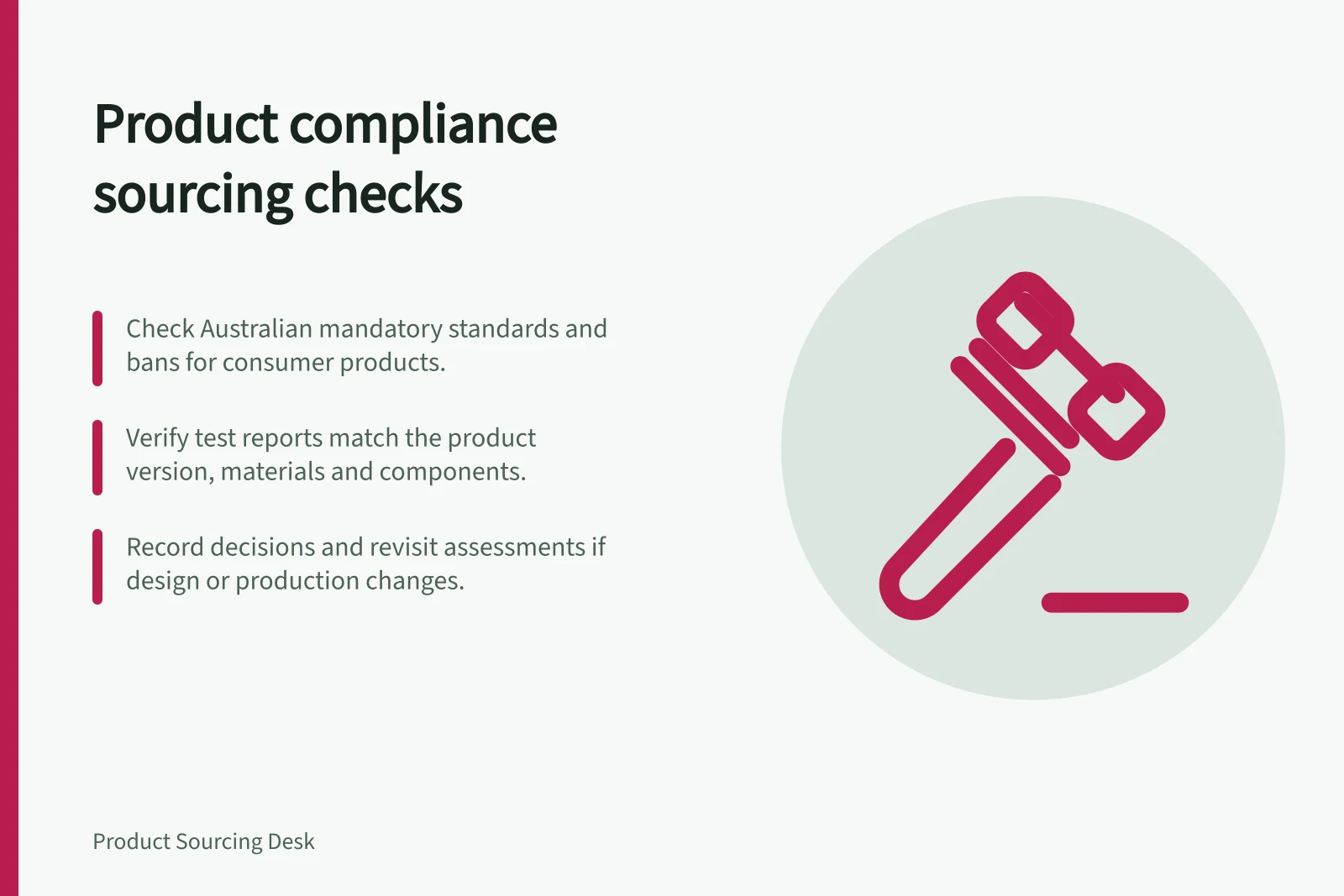
For consumer products, check the current Australian mandatory standards and product bans. Read the scope of any potentially relevant rule: a search result is only a starting point. Not every consumer product has a mandatory standard, but products sold to consumers still need to be safe. Electrical goods, food and therapeutic goods may also involve specialist regulators.
Record each possible requirement, why it may apply and what evidence would address it. Seek qualified advice where classification remains uncertain.
A new toppling furniture mandatory standard started on 4 May 2025, illustrating why a recorded assessment should be revisited when requirements change.
Separate mandatory rules from guidance
Mandatory standards set compulsory safety or information features for specified products, and supplying goods that fail a relevant mandatory standard is an offence. Industry standards may also address safety, but following them is voluntary unless another applicable requirement makes them relevant.
Mandatory safety standards set minimum requirements intended to reduce injury risk. Information standards require important information to help consumers decide whether to buy; they are not necessarily safety requirements. Keep these purposes distinct when documenting what a test or certificate is meant to demonstrate.
Check for bans and identify the supply obligation
A product ban is a separate check from a mandatory standard: a banned product must not be supplied. For example, the ACCC identifies baby bottle self-feeding devices as banned because of the risk of injury or death. The ACCC says mandatory standards and bans are introduced when evidence shows a high risk of serious injury, serious illness or death.
Product safety responsibility applies even where a product has no mandatory safety requirements. The ACCC describes manufacturers, importers, distributors, retailers and hirers as suppliers, and supply includes sale, exchange, lease, hire and hire-purchase. Map your role in the supply chain before approving an order.
Match evidence to the goods
Request complete test reports or product certification relevant to the identified requirement. Compare the document with the approved specification and order: model, variants, materials, components and, where relevant, stock or batch identifiers. Read the methods, results and limitations. If a mandatory standard applies, check that the evidence addresses its relevant requirements.
Reassess evidence after a design, material or production change. A report for an earlier sample may no longer represent the goods supplied. A pre-shipment inspection is an additional check; its scope must be assessed separately from laboratory testing.
Testing during product development can inform risk management and stock choices, but a pre-production sample alone may not establish that later goods are safe without further quality assurance. Keep the evidence linked to the claim and product version being approved, and reopen the review when the basis for that claim changes.
Choose evidence that can support the decision
The ACCC recommends reliable, independent testing, preferably by an accredited laboratory, with a test report. A supplier's written evidence may include third-party product certification or test reports; request copies so the basis of the compliance claim can be reviewed rather than relying only on an assurance.
Testing can also help establish whether a product is within a ban, or substantiate claims beyond safety. Depending on the claim, evidence may concern environmental impacts, emissions or efficiency, ingredients or components, country or place of origin, production methods, or health impacts. Identify the claim being relied on and check that the evidence addresses it.
Check what a certificate covers
Distinguish a management-system certificate from laboratory accreditation and product certification; check what each document actually covers.
Check the named entity and site, certified activity or product, referenced requirement, dates and exclusions. Verify current status with the issuer or relevant register when the decision depends on it. A certificate supports only the claim within its actual scope.
Understand the role of product certification
A certification agency can assess products and provide written certification of compliance with safety standards. The ACCC says this may allow certification labelling on relevant products. Treat the label as a claim to verify against the certification itself, the product version and the requirement, rather than as a substitute for checking the certificate's scope.
Record the decision
A short record can capture the approved product version, requirements considered, evidence reviewed, gaps, responsible reviewer and next action. Keep a material compliance question open until it is resolved. If the goods change, revisit the assessment before supply. Receiving checks can confirm that the delivered goods match the approved version, but they do not replace the underlying compliance assessment.
Supplying goods that do not meet relevant mandatory standards can lead to enforcement action and fines or penalties under the Australian Consumer Law. Non-compliance can also expose a business to legal liability and costs such as repairs, replacements, refunds or redesign.
Escalate questions to the right place
Product safety regulation is shared across government. Specialist agencies oversee particular product types, while Commonwealth, state and territory consumer protection agencies cover general consumer products; local government also has a role in some sectors. Where responsibility is unclear, agencies may work together to manage product safety.
The ACCC educates businesses, reviews mandatory standards and works with other regulators on serious product hazards, but it does not give legal advice about which standards apply or test products for compliance. If classification or evidence remains uncertain, seek qualified advice or contact the regulator responsible for the product before relying on the claim.
In this guide
- Identifying product-specific requirements before orderingDescribe the exact product, check current Australian standards and bans, and record unresolved regulatory questions before ordering.
- Requesting test reports that match the actual productCheck a supplier’s full test report against the exact model, variants, stock and Australian requirement before relying on its result.
- Checking the scope and date of a supplier certificateReview the certificate type, holder, product or activity, dates and current status before using it as sourcing evidence.
- Seeking qualified advice when compliance evidence is unclearChoose the right specialist, prepare a focused product brief and record the limits of advice before resolving a sourcing compliance gap.