Quality Inspection
Part of Product compliance sourcing checks
Requesting test reports that match the actual product
Check a supplier’s full test report against the exact model, variants, stock and Australian requirement before relying on its result.
Ask for the complete test report for the model and variants you intend to buy. Compare its sample description, methods, results and limits with the approved specification and the relevant Australian requirement. A “pass” summary has little value if it concerns another product or omits a required test.
Verifying a supplier test report before supply
- Request the full report for the models and variants you intend to buy, including every page and attachment
- Identify the sample and compare its description with the approved specification
- Check each relevant test against the applicable Australian requirement
- Verify the laboratory's accreditation scope and, if authenticity is in doubt, the report itself
- Resolve any open gaps before the goods are supplied
Request the report and identify its sample
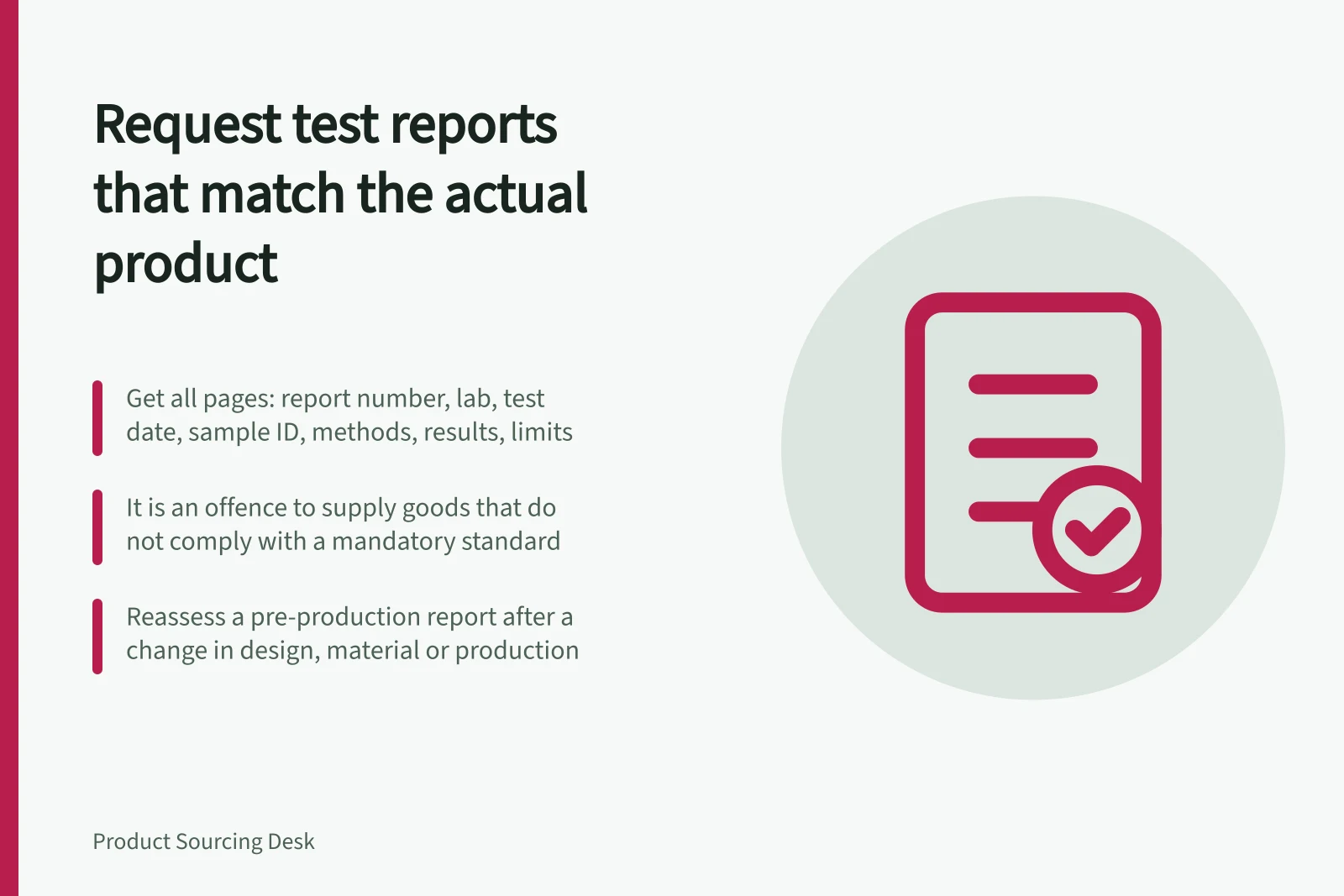
Give the supplier the approved specification and ask which report covers each order line. Obtain all pages and attachments, including the report number, laboratory, test date, sample identification, methods, results and stated limitations. Ask how the sample relates to the current production version and, where relevant, the stock or batch being supplied.
List differences in size, material, component, construction or manufacturing source. A difference does not automatically make a report unusable, but someone competent must assess whether the tested sample still represents the goods. One tested variant or component does not automatically establish compliance for every variant or the finished product.
What a complete test report should include
- Report number
- Laboratory that issued the report
- Test date
- Sample identification and description
- Methods used
- Results and stated limits
- Stated limitations
- All pages and attachments
- How the sample relates to the current production version, stock or batch
Check the tests against the requirement
Read the applicable Australian requirement alongside the report. Mandatory standards specify the safety or information features that are compulsory for certain products, and it is an offence to supply goods that do not comply. Check that every relevant requirement was tested and passed, and investigate any item marked “not tested”, “not applicable” or excluded.
Product safety guidance recommends asking suppliers for written evidence of safety compliance through third-party product certification or product testing, including copies of test reports, preferably from accredited test bodies or laboratories. Compare batch identifiers and delivery details where available. If authenticity is in doubt, ask the laboratory to verify the report using contact details obtained independently.
If the laboratory claims accreditation, check its current scope for the relevant test or part of a standard. Accreditation for one method does not cover another automatically. Accreditation is not compulsory for every test laboratory, so an absent accreditation mark calls for a competence assessment rather than an automatic conclusion that the report is unlawful.
Resolve gaps before supply
Reassess a pre-production report after a change in design, material or production. If reports conflict, check whether they used the same specification and methods, and discuss the discrepancy with the laboratory and NATA where relevant.
Record which models and requirements the report covers, what remains open and who is resolving it. If evidence does not establish compliance with an applicable mandatory standard, obtain suitable further testing or advice before supplying the goods. A visual inspection cannot, by itself, establish a result that requires a laboratory test.
Gaps to resolve before supply
- A design, material or production change since the report was issued
- Conflicting reports that used different specifications or methods
- Requirements marked 'not tested', 'not applicable' or excluded
- No evidence of compliance with an applicable mandatory standard
- Accreditation claimed for a method or part of a standard outside the laboratory's current scope
- Variants or order lines not covered by the tested sample