Samples & Specifications
Part of Managing repeat supplier orders
Checking whether a repeat order matches the approved specification
Compare a repeat order with the approved product version, document differences and confirm what the supplier will make.
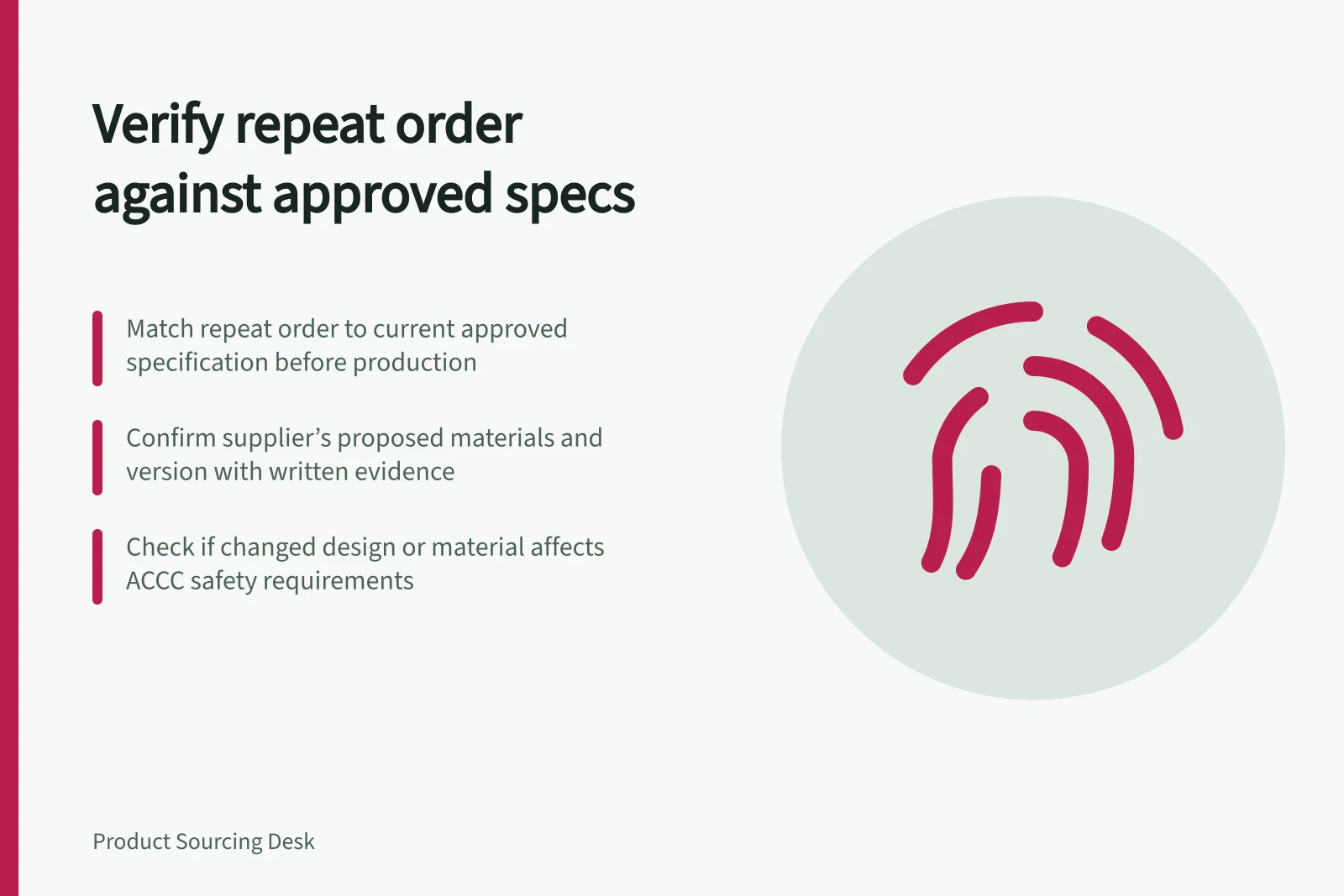
Match the proposed repeat order to the current approved product specification before production starts. Identify the exact version and variants, ask the supplier to confirm what it will make, and resolve each difference as a proposed change.
Use the last delivery to help locate the baseline, but it may have contained an exception that should not be repeated.
Find the controlling record
Gather the latest approved specification, purchase order, sample reference, applicable artwork and packaging versions, and written change approvals. Check which orders and variants each covers.
If two files conflict, find the authorised decision rather than choosing the most recently emailed attachment.
List the requirements that matter to the product: dimensions and fit, materials or components, construction, finish, included items, variants and customer-facing description. Refer to the approved packaging record for detailed artwork and carton instructions.
Ask the supplier to identify differences
Send the baseline identifiers with the proposed quantity by variant. Ask the supplier to mark each material requirement same, different or unconfirmed, and to describe its proposed version.
“We can repeat it” does not identify which version it intends to make. Confirm the production site or critical subcontracted step if it formed part of the earlier approval.
Comparison / Record before approval
- Approved item
- Specification, sample and affected variant identifiers
- Proposed item
- Supplier’s stated materials, components and production route
- Difference
- What would change and which units it would affect
- Evidence
- What would show the revised item is acceptable
- Decision
- Approver, date and applicable order lines
Appearance alone does not establish that a changed component or material is equivalent.
Approved vs Proposed Item: Key Differences to Track
- Proposed item
- Supplier’s stated materials, components and production route (e.g., new factory in Vietnam)
- Evidence
- Test reports, equivalence statements, or updated samples showing acceptability
Resolve changes before giving production instructions
A substitute, new tooling, altered assembly step or changed factory may affect an earlier sample or test report. Ask what stock has already been made to each version.
Reject the change, seek a revised sample or suitable test, or approve it with a dated specification revision. Record any effect on price and timing under the order’s change process.
For consumer products supplied in Australia, assess whether earlier safety evidence still covers a changed design, material or production method. The ACCC advises further quality assurance beyond safety testing a pre-production sample. A supplier’s statement of equivalence does not resolve a product-specific requirement.
Confirm what will be made
Confirm the purchase order or other written order against the approved version, quantities and authorised exceptions, and obtain the supplier’s acknowledgement. Give that version to whoever will inspect or receive the goods.
Compare actual goods with it at an appropriate point and record what the check covered.
Record the result as match confirmed for the stated version, change approved with stated further checks, or hold pending a named answer. An unexplained “repeat order” label is not a product approval.