Quality Inspection
Managing repeat supplier orders
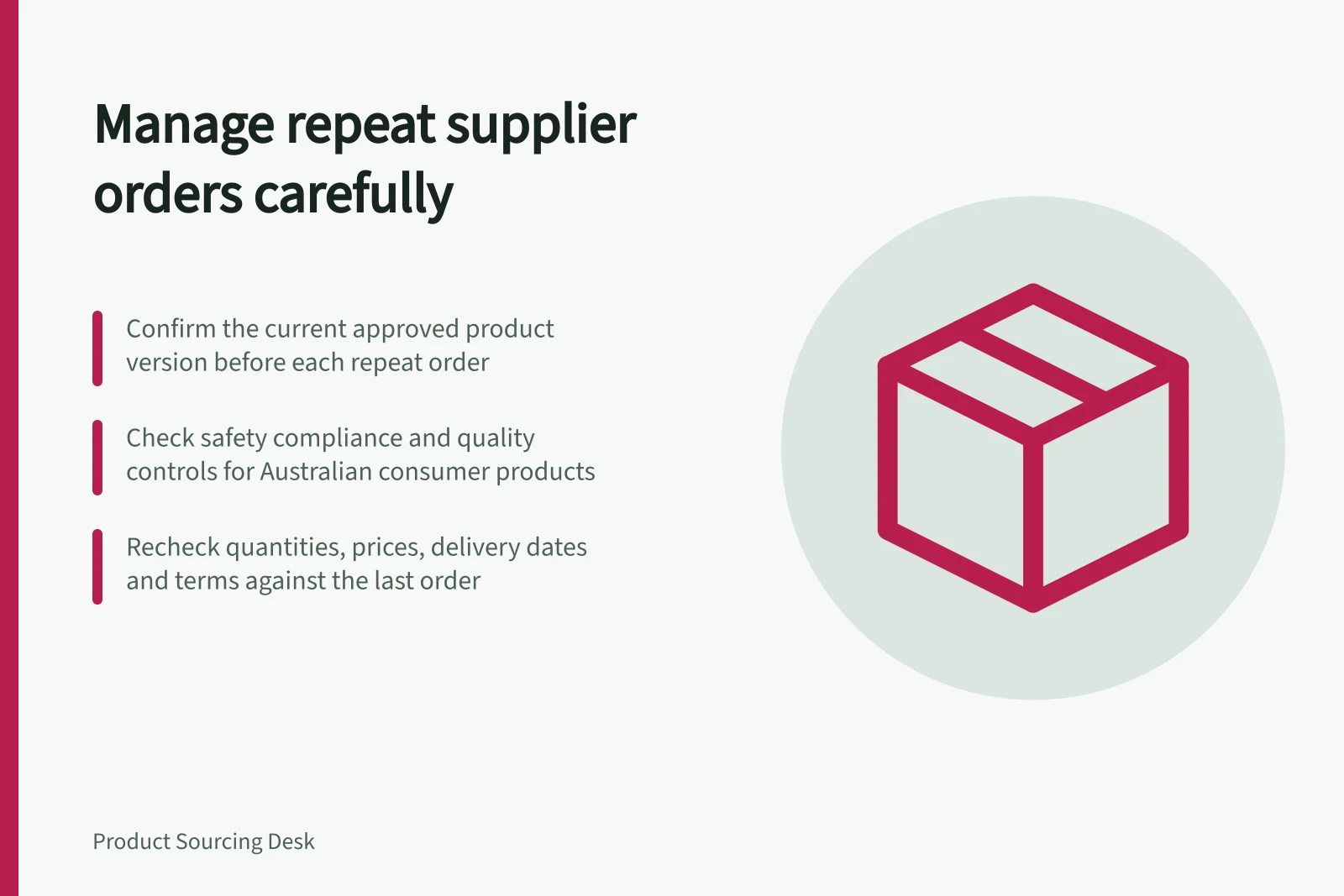
Manage repeat supplier orders by confirming the approved product, current terms and delivery results before deciding what to order next.
Treat every repeat order as a new commitment against the current approved product version. Before placing it, confirm what the supplier will make, the quantity, price and delivery need, plus any changes since the last accepted delivery. After receipt, record what arrived before deciding whether to repeat, adjust or pause the next order.
Start from the approved version
Keep the current specification, approved sample reference, variant list, quality criteria and authorised changes together. Name the relevant packaging and artwork versions on the order. “Same as last time” is ambiguous if the previous shipment included a temporary concession or a corrected batch.
Ask the supplier to confirm the version it will make and identify proposed differences before production. Check a change in materials, components or production route where it could affect fit, safety or customer claims.
For consumer products supplied in Australia, a design, material or production change may call for fresh assessment of earlier safety evidence. Safety testing a pre-production sample is generally insufficient without further quality assurance.
Recheck product-safety assurance
If you supply consumer products in Australia, you are legally responsible for their safety, whether or not mandatory safety requirements apply. A repeat order does not remove that responsibility. Before releasing the order, check that the product is not subject to a ban and that any applicable mandatory safety standard is addressed.
The ACCC recommends sourcing from manufacturers or suppliers with a reputation for supplying products tested for compliance with applicable mandatory standards. For an established supplier, review whether the controls behind that reputation remain in place. If relevant evidence is missing, resolve the gap before treating the previous order as assurance.
Supplier controls to check include regular factory audits, raw-material testing, adherence to assembly-line processes and quality checks. The ACCC also identifies current and adequate staff training as a sourcing check. These controls help assess whether the supplier can keep making the approved product consistently.
Check whether a mandatory safety standard applies; if one does, testing may be required. Testing can also help establish whether a product falls within a ban and cannot be sold in Australia. Depending on the product and claims, testing may help establish acceptable quality or substantiate claims about ingredients, components, emissions, efficiency or origin.
You can commission reliable, independent testing, preferably through an accredited laboratory, or conduct your own testing if you have suitable expertise and facilities. You can also commission a certification agency to assess the product and provide written certification of compliance with safety standards. Choose an approach suited to the product and the evidence required.
Ask the supplier for written evidence of safety compliance through third-party certification or product testing. Request copies of relevant test reports; the ACCC recommends reports from accredited test bodies or laboratories where possible. Keep the evidence with the order record so the next release decision can take account of what it covers.
Recheck the commercial commitment
Compare the proposed order with the last one: quantities by variant, unit price and currency, recurring charges, payment dates, goods-ready date, delivery point and responsibility for remaining services. Confirm whether the quoted lead time starts at order acceptance, deposit, artwork approval or another event. Record the agreed trigger.
Base the quantity on current demand and stock rather than automatically repeating the previous purchase. Check whether the minimum order, expected arrival, cash requirement and storage still fit. Leave an unquoted charge or date open until the supplier answers it.
Use a short release check
Decision / Evidence to keep
- Product version
- Supplier acknowledgement of the specification and authorised changes
- Order terms
- Accepted purchase order or written variation
- Quality
- Checks appropriate to the product and known issues
- Timing
- Agreed goods-ready date and remaining approval steps
- Dispatch
- Accepted quantity, open defects and packing details
A routine order may need a compact record. A changed product, earlier defect or critical delivery date may justify more checks. Agree an inspection’s scope and acceptance rules before seeing its results. Checking some units does not establish that every unit is sound.
Close each delivery before reordering
Compare ordered, shipped and accepted quantities by variant. Record the relevant goods-ready and arrival dates, defects, shortages, corrections and documented extra work or cost. Keep an issue open until the remedy and affected stock are clear. Review the supplier’s explanation alongside the receiving record.
Decide whether to reorder on the same basis, change a term or check, request corrective action, trial another source or hold the order. Record why. One late shipment may have a specific cause; repeated changes in timing or quality results deserve closer analysis.
For a product whose interruption would materially affect the business, prepare an alternative source before it is urgently needed. That source needs its own product and delivery assessment. A contact name alone is not a ready substitute.
The order record should let the next buyer see what was authorised, what the supplier acknowledged, what arrived and which questions remain open.
Include changes to mandatory standards, bans and recalls in the next-order review. The ACCC advises businesses to keep up to date with these through its product safety emails. If an update is relevant to the product, resolve its implications before authorising another order.
In this guide
- Checking whether a repeat order matches the approved specificationCompare a repeat order with the approved product version, document differences and confirm what the supplier will make.
- Reviewing supplier performance after each deliveryReview a supplier delivery against agreed goods, dates, quality and cost, then record the action needed before reordering.
- Tracking changes in lead time and defect ratesUse consistent timing events and checked-unit counts to compare repeat orders without overstating sampled defect results.
- Building a second source for a critical productAssess an alternative supplier for a critical product by checking product match, order terms, shared dependencies and readiness.