Samples & Specifications
Part of Negotiating with suppliers
Agreeing on a written change process
Supplier relationships change after the first order.
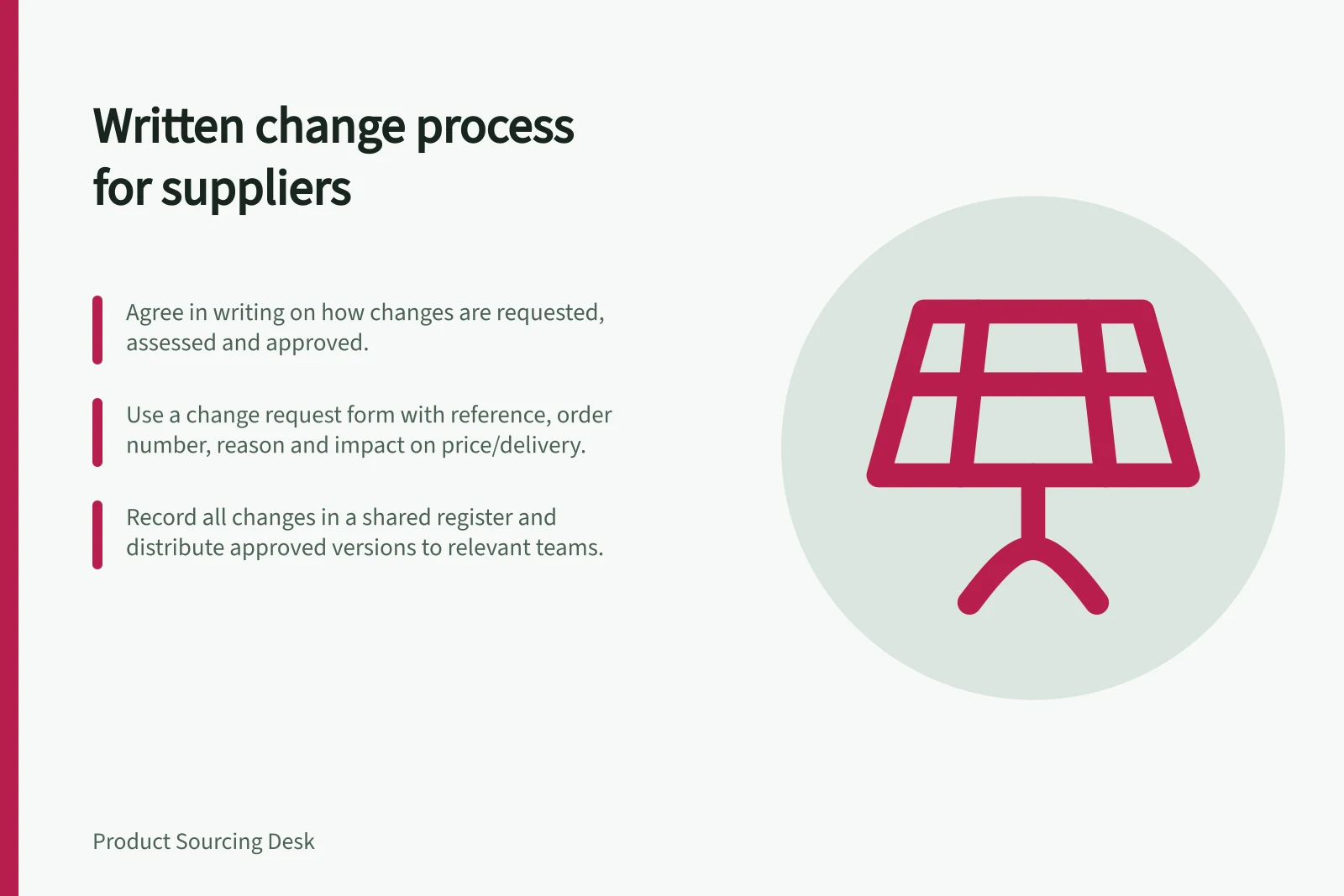
Before placing an order, the buyer and supplier should agree in writing how either party can request a change, how it will be assessed, who can approve it and how the decision will be recorded.
Apply the process to changes such as a material substitution, revised lead time or new price that could affect products already promised to customers.
Define the trigger and authority
List the changes that require written approval: specification, material, country of manufacture where relevant, price, quantity, packaging, quality test, ship date or subcontractor. Name the buyer and supplier contacts who can approve changes; a production email or call can flag a problem, but the decision should appear in a controlled order or specification revision.
Agree to use a change request form or variation notice. Give each request a reference and record the order number, affected requirement, current and proposed wording, reason, requester and date. Include the expected effects on price, delivery, risk and other terms.
Set out who assesses requests and who may approve them. Agree any value limits or other approval conditions, who signs above those limits, and how long the recipient has to acknowledge, assess and decide. Name the person each party should contact if a request is unanswered by the agreed deadline.
Assess each request against its effects on delivery, price, risk and other terms. Record whether it is approved, rejected or needs more information; do not treat a request or an unanswered email or call as approval.
The Australian Department of Finance publishes guidance titled Contract Variations for public procurement. Private buyers should follow their own contract; public procurement rules do not automatically govern their orders.
Close the loop
For an approved request, issue a written variation or revised order linked to its request reference. Record the old and new requirement, reason, cost and timing effect, approval, effective date and affected open order numbers. Agree that the change takes effect on the date stated in the approval, not before it.
Keep a change register in a location agreed by the buyer and supplier. Record each request reference, its status, decision and the current specification or order revision, so the parties can identify which version applies.
Distribute the approved version to receiving, quality and customer-facing staff. Check that the invoice and delivered goods match it.
When a supplier changes something without approval, record the non-conformance and decide whether to accept, rework or reject under the actual agreement rather than quietly updating the record afterwards.
Key Requirements for Change Management in Australian Supply Chains
- Required documentation
- Written variation or revised order with reference to original request
- Change register location
- Agreed shared system accessible to both buyer and supplier
- Effective date of change
- Date stated in approval—not earlier than that
- Distribution of approved changes
- To receiving, quality, and customer-facing teams