Supplier Shortlists
Responsible and resilient sourcing
Check supplier claims, identify critical supply dependencies and prepare a response before an interruption affects Australian stock.
Responsible sourcing means examining the environmental and social risks connected with the goods you buy and checking claims before relying on them. Resilient sourcing means understanding what could interrupt supply and preparing a workable response. For an Australian buyer, start with the products whose absence would matter most, then examine their claims and dependencies together.
Choose where to focus
List priority products and identify the approved version, invoicing supplier, site doing critical work and any material or component that would be difficult to replace. Mark information unconfirmed when the supplier has not established it.
Match the depth of review to the decision. A recycled-content claim needs evidence connected to the goods being purchased. A product with a unique component needs a response if that component becomes unavailable. A large file of supplier documents is useful only when it answers the relevant questions.
Check claims against the goods
Ask what each environmental or social claim covers: a material, finished product, site, period or the supplier’s wider business. Request records that connect the claim to the proposed goods, and record exclusions and conditions.
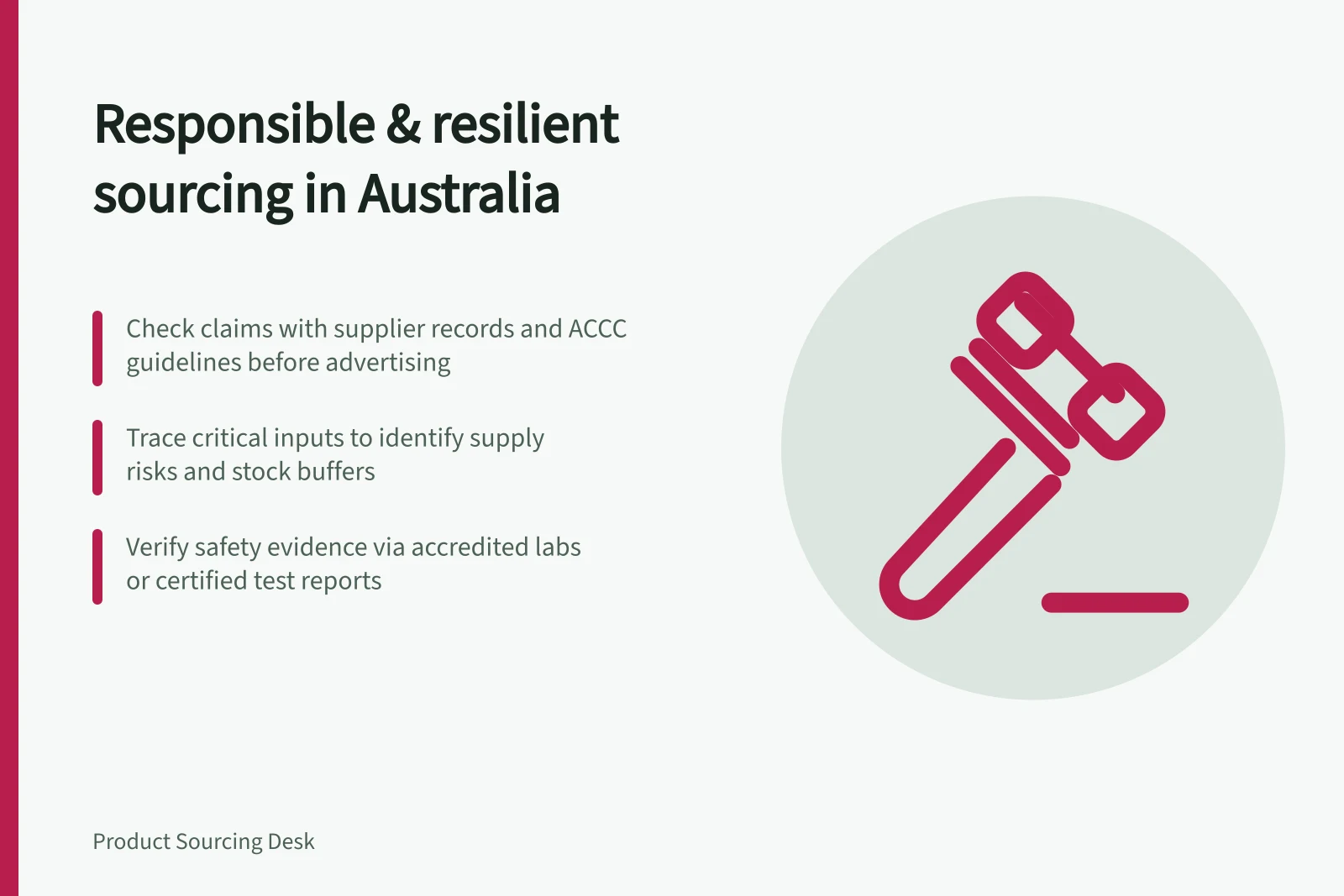
Before making an environmental claim to Australian consumers, review the wording, images and packaging together. The ACCC educates consumers and businesses about their rights and responsibilities under consumer law, accepts reports about potentially misleading claims and may investigate. A supplier statement or certificate may support a narrower claim than the proposed advertising. Where support is incomplete, use only wording the evidence justifies or hold the claim.
A social audit can inform a decision within its stated scope. Record the site, period, methods, access limits, findings and follow-up. No reported finding is not a promise about every worker or subcontractor.
Account for supply-chain complexity
A UNSW Business School discussion notes that globalisation has made supply chains complex and poor ethical practices harder to track and address. For a product range, keep the confidence level of claim evidence visible alongside supply continuity risks. Do not treat a supplier’s wider commitments as proof about every product or production link.
Find where supply could stop
Trace each priority product through its critical input, production site and delivery handover. Ask whether different sellers share a factory, tooling, material source or constrained process. Separate confirmed links from supplier statements and unknowns.
For each important dependency, compare usable stock and credible replenishment timing with the date goods are needed. Identify what could be substituted and what would require a new sample, assessment or customer-facing description.
For each critical input, record what could interrupt supply. Note how much stock or time is available to absorb the disruption, and what action could enable a switch or other adaptation.
Prepare a response
Compare possible alternatives against the same product requirement, quantity and Australian receiving point. Distinguish a contact from a candidate with relevant product evidence, and from a route with agreed ordering and availability terms. An indicative quotation does not reserve capacity.
Name the event that would prompt action, who may approve a change and what evidence they must review. If an alternative changes a consumer product, reassess the requirements and safety evidence for the version that would actually be supplied.
Keep a dated decision record covering claims, evidence, dependencies, alternatives, open questions, action owners and the next review. Update it when the product, site, material, claim or delivery commitment changes.
Keep safety evidence in range decisions
In Australia, a business supplying consumer products is legally responsible for their safety. This covers products under a mandatory safety standard or ban, and products without mandatory safety requirements. At portfolio level, include whether relevant safety evidence is available when judging how quickly a product or alternative could be supplied. Detailed product compliance assessment remains a separate task.
The ACCC Product Safety guidance describes several ways to obtain testing or compliance evidence. Commission a reliable, independent and preferably accredited laboratory; use suitable in-house expertise and facilities; or engage a certification agency. Request written supplier evidence, including test reports, preferably from accredited test bodies or laboratories.
Testing can help identify whether a product meets mandatory standards or falls within a ban, and can reduce the risk of injury, recalls and compensation claims. The guidance also notes that a pre-production sample tested for safety is generally not enough on its own without further quality assurance.
In this guide
- Asking for evidence behind supplier sustainability claimsDefine a supplier sustainability claim, request records covering the actual goods and decide what wording the evidence supports.
- Mapping dependence on one factory or materialTrace a product to critical factories and inputs, identify shared dependencies and record where an interruption could affect supply.
- Comparing supplier alternatives before an emergencyCompare contingency routes against the same disruption, product requirement, delivery need and activation conditions.
- Documenting the limits of a supplier auditRecord an audit’s site, date, criteria, methods and access limits so its findings inform only decisions within its scope.