Samples & Specifications
Part of Packaging and labelling specifications
Avoiding inconsistent packaging across repeat orders: steps
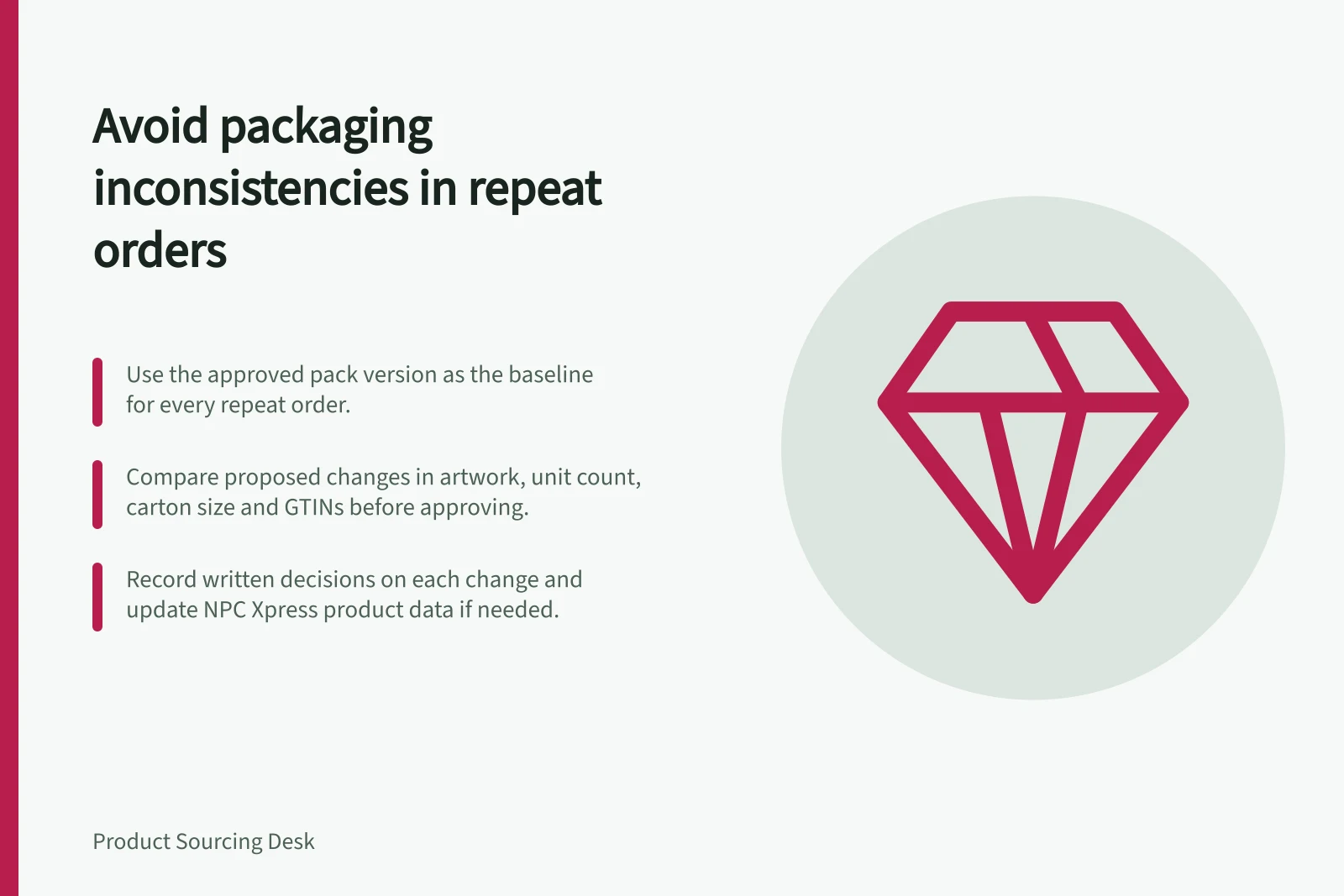
Use an approved pack baseline, compare changes and update carton or product data before placing and receiving repeat orders.
Use the approved pack version as the baseline on every repeat purchase order. Before production, compare the supplier’s proposed pack with it, then approve or reject each difference in writing. A repeat order does not establish that cartons, labels or unit counts will match the last accepted run.
Keep a pack baseline
Keep the approved retail artwork and label files, carton construction or measured dimensions, specified materials, units per inner and outer pack, packing instructions, and a reference to the assembled pack. Record the pack version, variants and purchase orders it covers. Photographs help identify layout but do not replace written dimensions or counts.
Ask the supplier to confirm the file versions and instructions it will use. A familiar filename is not enough if its contents have changed.
Compare proposed differences
| Compare | Why it matters |
|---|---|
| Retail artwork and label text | A changed claim, warning or variant name may no longer match the product or applicable requirement. |
| Contents and unit count | Receiving records and customer expectations depend on the count. |
| Carton construction and protection | Removing a divider or changing the box can affect arrival condition. |
| External dimensions and gross weight | Freight estimates and trading-partner product data may need updating. |
| Barcode and carton identifier | Each code must identify the intended trade item and packaging level. |
Mark each line same, changed with approval or open. Ask what prompted the change and which order lines it affects. The explanation guides what to recheck; it is not approval. Record a decision against every changed line in writing before production.
Where GS1 GTINs identify a pack or case, consult GS1 Australia’s GTIN Management Standard and GTIN Management Decision Tool before reusing an identifier after a pack-count or physical change. NPC Xpress says minor dimension changes of less than 20% do not require a GTIN change. In NPC Xpress, a Pack Size Change means changing the number of Base Units in an Inner or Case, and NPC Customer Support must make that change.
Key Facts on Packaging Consistency and Compliance
- GS1 GTIN Rule: Minor dimension changes <20%
- Do not require a new GTIN under NPC Xpress guidelines.
- Pack Size Change Definition
- Changing the number of base units in an inner or case pack.
- GTIN Reuse After Change
- Must consult GS1 Australia’s GTIN Management Decision Tool.
- ACCC Oversight
- Businesses must be able to substantiate claims about products or services.
- National Product Catalogue (NPC) Updates
- Users can update and publish product data via NPC Xpress.
Check the proposed run
Request an assembled retail pack and a filled carton from the proposed run. Compare print, contents, sealing, cushioning, count, external dimensions and gross weight with the baseline.
If a pack change alters a product claim, verify it before approval: the ACCC can require businesses to back up claims about products or services and may investigate misleading or false claims. If the product itself changes, check affected product-specific requirements separately before approving the packaging.
When a change is accepted, issue a new pack version and state which purchase orders it covers. Retain the old version so mixed stock can be identified. Update relevant warehouse, retailer and carrier information before goods move.
Where product data is held in the National Product Catalogue, NPC Xpress lets users update products and publish them to a retailer.
For a rejected difference, request a correction and evidence from the corrected pack.
At receipt, record whether cartons and retail packs match the version approved for that order, including any authorised exception. Add the observation to the next order’s baseline.