Freight & Payments
Part of Product sourcing for an Australian business
Choosing a sourcing route for a first order
Compare a local stockholder, direct producer and intermediary by responsibilities, cash commitment, product evidence and first-order control.
A first order can run through a local stockholder, directly from a producer or through an intermediary. Choose by confirming who sells and makes the goods, who coordinates delivery and import tasks, and who handles problems. The lowest unit price alone does not show which route leaves your business with workable responsibilities.
Identify the parties and their roles
Use the same product brief, estimated quantity, delivery need and cash limit for each route. Ask for the invoicing party, producer if different, delivery point and contact for product questions. A marketplace profile or local address does not establish that the seller owns the factory or that goods are Australian made.
With a local stockholder, confirm whether it has the required variant available and whether it will sell and invoice the goods or arrange supply another way. With a direct producer, identify the maker and invoicing party separately, then agree who coordinates delivery, import and any checks. An intermediary may sell the goods or arrange a purchase from another party; establish which role it will take and which coordination tasks it will perform.
For each route, assign responsibility for freight, inspection, import requirements and resolving product problems rather than assuming the seller will handle them. A producer or intermediary may be based in Australia or overseas, so confirm the actual parties and delivery arrangement for the order.
Search for the supplier on the Australian Business Register to confirm it is a legitimately registered business. This check does not establish that the supplier is the producer or verify the product.
| Route to investigate | Reason it may fit | Confirm before committing |
|---|---|---|
| Local stockholder | You want to assess available stock and a domestic delivery offer. | Exact product version, available quantity, replenishment plan and defect process. |
| Direct producer | You need to discuss product changes with the party making the goods. | Production capability, minimum order, approval process and who coordinates delivery or import. |
| Intermediary | You want a party to coordinate specified supply tasks. | Which tasks are included, who sells and manufactures, how changes are approved and who handles defects. |
A local stockholder may not have the variant you need; a producer may accept a small first order; an intermediary may offer narrow or broad coordination. Check the proposed stock, quantity and assigned tasks rather than relying on the route label.
Price the work left with your business
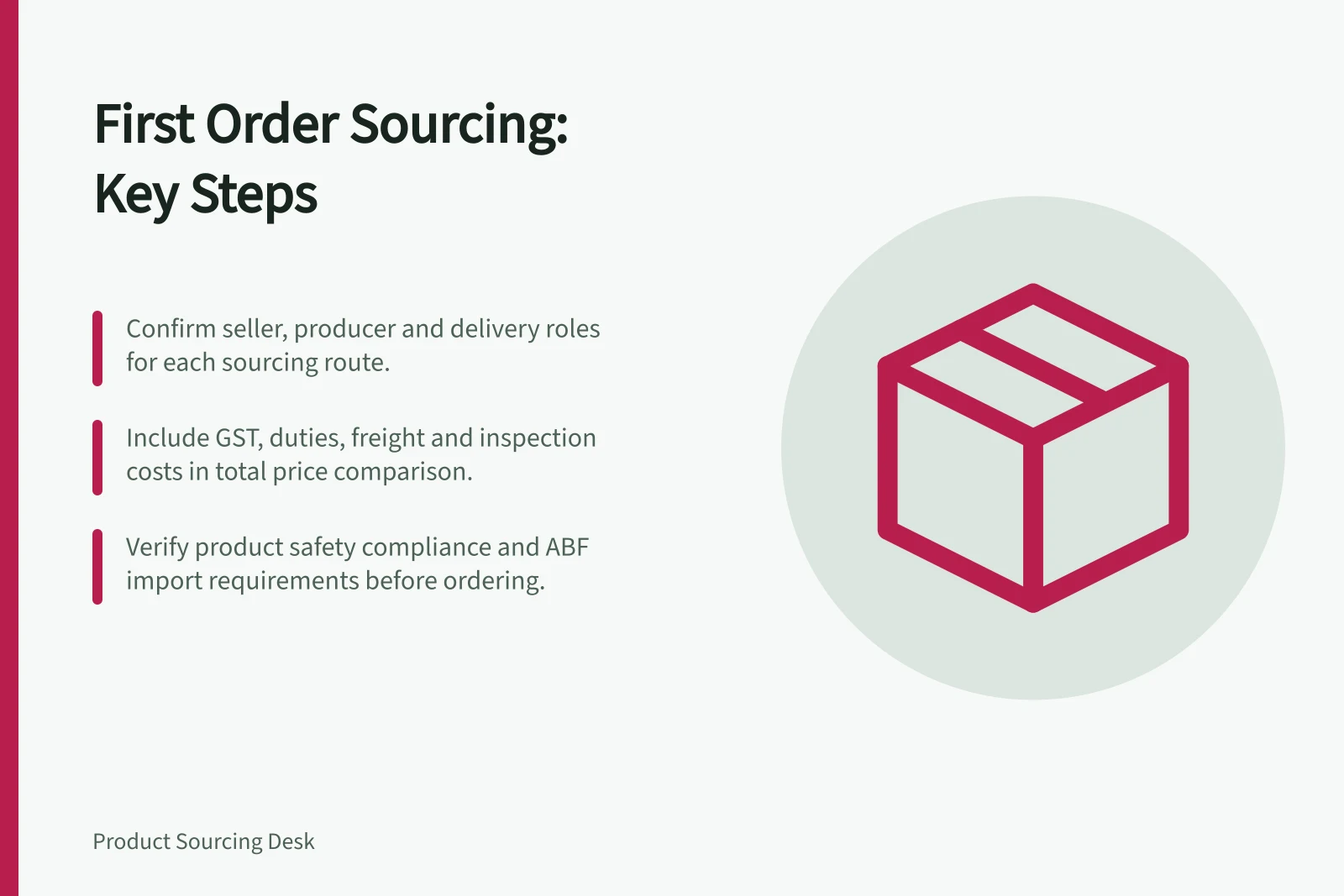
Compare the amount payable for usable stock at your receiving point. Record samples, setup, product price, freight, inspection, duties and taxes where applicable, clearance, local delivery and storage. Ask which costs are included in each offer, who pays them directly and who bears costs for delays or corrections.
For imported goods, most imports are subject to 10% GST. Depending on the type and value of the goods, customs duties, import processing charges, transport, insurance, storage and other handling charges may also apply.
Check payment timing as well as total cost. A large order or early payment can strain cash before sales begin, so check that the first commitment fits the stock you can reasonably receive and review.
Include Australian checks
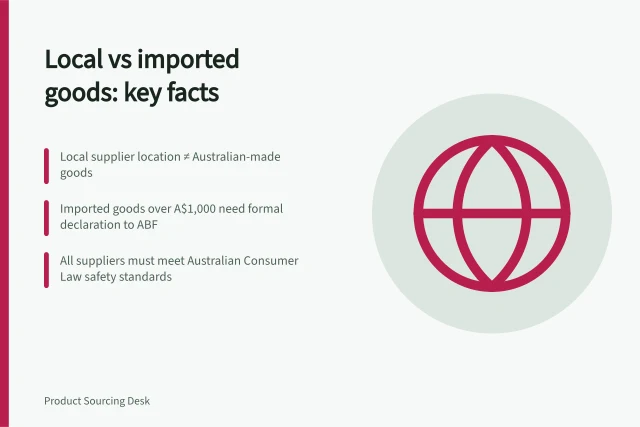
If importing, the Australian Border Force (ABF) clears goods through customs. Most goods valued up to A$1,000 can be imported without a formal import declaration; requirements are generally more complex for goods over A$1,000, prohibited or restricted goods, biosecurity-risk goods, and goods subject to duty or taxes.
A formal Import Declaration is called an N10 and is lodged electronically through ABF’s Integrated Cargo System (ICS). Before ordering, check with ABF whether the goods need a permit or other clearance requirements, and check the Department of Agriculture, Fisheries and Forestry’s Biosecurity Import Conditions system (BICON) for biosecurity conditions.
If you supply consumer products in Australia, your business is legally responsible for product safety. The Australian Consumer Law (ACL), enforced by the ACCC, includes mandatory product safety and information standards for some products; check the ACCC’s list for the product you plan to supply.
Ask for written safety evidence relevant to the product and its variants, such as product testing or third-party certification. Where a mandatory standard applies, confirm who will obtain the evidence and arrange any required checks; an intermediary’s involvement does not establish that the product complies.
Make a reviewable commitment
Choose a route whose open questions can be resolved before ordering and whose first-order quantity you can fund. Record the approved specification, seller, producer if different, delivery point, included services, payment stages and dates, and who handles import and product checks.
Agree how product problems will be handled, including who arranges and pays for repair, replacement or a refund where relevant. If a task is described only as “handled”, ask what the party will deliver and record the responsibility in the order terms.
Review the first delivery against those commitments. Note product match, timing, total cost and the work your team had to do, then use that record to decide whether to repeat the route, change its terms or investigate another one.