Freight & Payments
Part of Supplier payment risk
Comparing deposits with staged supplier payments
Compare supplier deposits and staged payments by cash commitment, review opportunities and the terms for a failed stage.
Compare a deposit with staged payments by the cash due before goods can be checked, the evidence available at later payment points and what the supplier must fund. More instalments do not automatically reduce exposure: a large amount due at a vague early milestone may offer little more control than a large deposit.
Compare the commitments
Request the total order price and each payment’s amount, currency and due date or trigger. List setup and tooling charges separately if they are due before delivery. Confirm whether the deposit is credited against the balance and what the agreement says if the order changes or ends.
| Structure | Buyer question | Supplier question |
|---|---|---|
| Deposit, then balance before dispatch | How much is paid before finished goods can be reviewed? | What review and correction opportunity precedes the balance? |
| Several production-stage payments | What cumulative amount is paid at each stage? | What precisely completes each stage? |
| Balance after an agreed acceptance point | What must be accepted before payment? | Can the supplier fund the work until that point? |
These structures are for negotiation, not standard terms or a ranking. A supplier may need upfront funding for a customised order. The buyer must still assess the cash commitment and what can be verified before each release.
Map cash paid against evidence
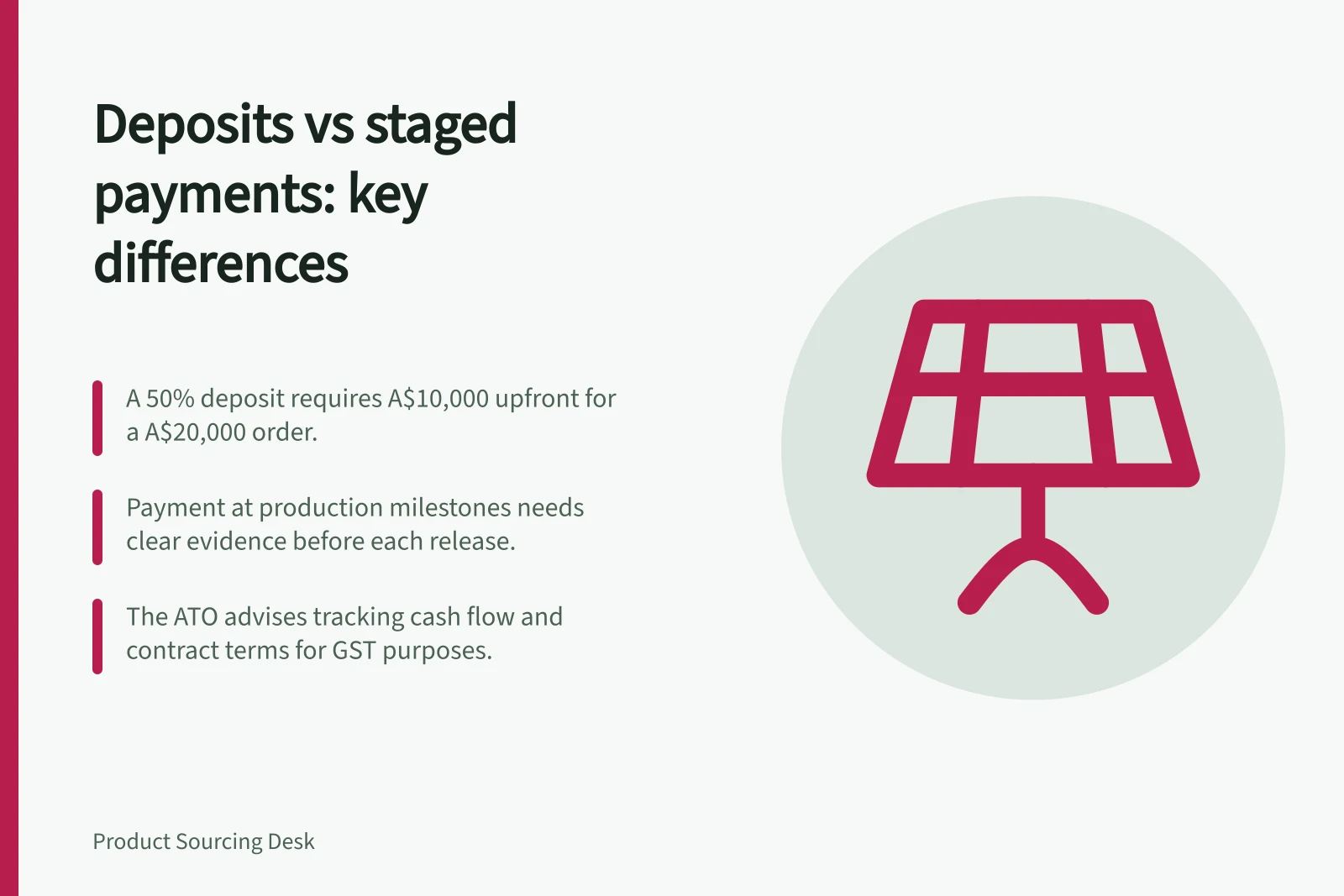
For a hypothetical A$20,000 order, a 50% deposit requires A$10,000 at the start. Under an alternative 20% deposit and 40% at a production milestone, A$4,000 is due initially and A$8,000 more at that milestone: A$12,000 paid in total.
The later decision point is valuable only if the buyer can assess the agreed evidence before the A$8,000 becomes due. These percentages illustrate arithmetic; they are not recommended terms. Cash paid is not necessarily the same as an unrecoverable loss.
Extend the map through dispatch and receipt. If the balance is due before shipping, agree when finished goods can be checked and how defects will be handled. If payment follows delivery, define acceptance and the invoice deadline. A date alone does not establish a right to withhold payment for a later concern.
Agree the response to a failed stage
Specify who reviews the evidence, the review period, whether correction and rechecking are allowed, and how a disagreement is handled. If only part of an order is ready, state whether the instalment covers the full order or an accepted quantity.
Choose a schedule both parties can perform and the buyer can fund. Keep it with the purchase order. Record any agreed change to the schedule; do not treat a new invoice or progress update as an automatic variation.