Freight & Payments
Supplier payment risk
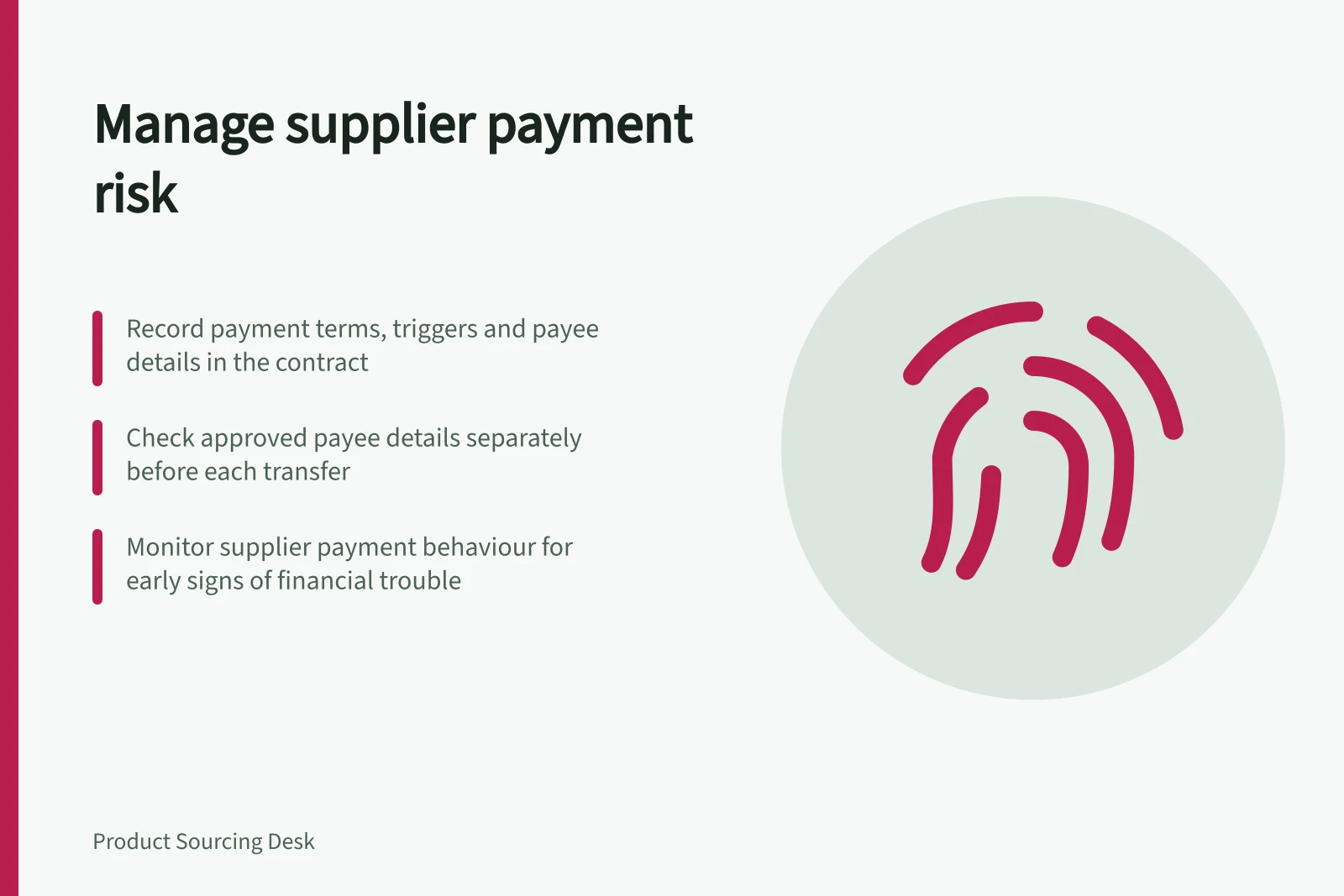
Manage supplier payment risk with agreed triggers, evidence checks, independent payee verification and a clear record of disputed amounts.
Supplier payment risk includes cash committed before goods can be checked, uncertainty about what releases each amount, paying the wrong account and difficulty resolving a disputed invoice. Manage it by agreeing each amount and trigger, reviewing the required evidence and checking approved payee details separately.
Without clear terms, a party may pay late, dispute the payment or refuse to pay. This can leave the business exposed to cash loss or delay.
Key risks and controls in supplier payments
- Risk: Paying before goods checked
- Common in deposit or progress payments without clear evidence review
- Risk: Wrong account payment
- Occurs when payee details are not verified independently
- Control: Independent payee verification
- Separate check of bank details before transfer
- Control: Documented decision trail
- Retain order, approvals, evidence and transfer records
Identify the exposure before ordering
Record the contracting and invoicing entity, product version, quantity, price, currency, delivery point and payment terms in the order. For each instalment, state its amount and trigger, and resolve any difference between the invoice and agreed order before paying.
At each stage, record the amount due and the cumulative amount already paid to see how much cash is exposed before the next evidence review. A deposit may commit cash before finished goods exist, while a later payment gives the buyer a review point only if the agreed evidence can be assessed before payment is due.
| Before paying | Check |
|---|---|
| Deposit | Is the seller identified, and can the business fund the commitment? |
| Progress payment | Has the agreed trigger occurred, and has the required evidence been reviewed? |
| Final balance | What goods and checks does this payment cover, and are exceptions resolved? |
| Any transfer | Do the approved payee details match the payment instruction? |
When economic conditions tighten, delayed payments and unpaid invoices can be early signs of trouble for a supplier. If your business is exposed to that supplier, monitor changes in its payment behaviour.
Before paying: Key checks to reduce supplier payment risk
- DepositIs the seller identified, and can the business fund the commitment?
- Progress paymentHas the agreed trigger occurred, and has the required evidence been reviewed?
- Final balanceWhat goods and checks does this payment cover, and are exceptions resolved?
- Any transferDo the approved payee details match the payment instruction?
Put payment terms in the contract
Payment terms are the rules for how and when payment is made. For sales, they form part of a sales contract under contract law and should state accepted methods, such as cash, bank transfer or credit card, and when payment is expected: all up front, in instalments, on delivery or after 30 days if credit is offered.
Payment terms should also cover conditions attached to payment and how overdue payments and debts are collected. Clear terms can help reduce financial risk and disputes.
A supply contract should say what products the supplier will provide and what conditions count as completion. It should also state how much, when and how the buyer will pay, who is responsible for faulty or incomplete goods, and how both parties will handle disputes; use plain English to reduce misunderstandings.
Payment terms in contract: What should be included
- Accepted payment methods
- Cash, bank transfer, credit card
- Payment timing
- All up front, instalments, on delivery, after 30 days (if credit offered)
- Conditions attached to payment
- Clear rules for what must be met before payment is due
- Overdue payment collection
- Process for handling late or unpaid invoices
- Dispute handling
- How disputes will be managed, including notice requirements
Make payment triggers specific
Agree what event makes each amount due, what evidence the supplier must provide, who reviews it and how long that review takes. The event might be approval of an identified sample, completion of a defined production stage or acceptance of a specified shipment lot.
State what happens if the evidence is incomplete or a check fails. A supplier’s progress update is distinct from the buyer’s acceptance of an agreed milestone, so allow time for inspection or testing before payment if those checks are required.
Several instalments can still leave most of the price payable before the goods can be checked. Also specify who is responsible for faulty or incomplete goods.
Verify the payee separately
Compare the approved payee details with the payment instruction as a check separate from reviewing the invoice or goods. Matching payee details does not establish that the goods meet the order or that a payment trigger has been met.
If bank details change, pause payment and follow the separate changed-bank-details verification process before paying. See our supporting guide to verifying changed supplier bank details.
If a transfer may have gone to fraudulent details, contact the bank immediately.
Steps to verify payee details before payment
- Step 1Compare approved payee details with payment instruction separately from invoice or goods review.
- Step 2If bank details change, pause payment and follow the separate verification process.
- Step 3If a transfer may be fraudulent, contact the bank immediately.
Watch for payment redirection scams
Scammers may pretend to be from a business you have used and send an invoice with new payee information. The aim is to redirect a legitimate payment to a scammer, so you believe you are paying for the goods you ordered while the money goes elsewhere.
An invoice that matches the products ordered does not confirm that its new payee details are genuine. Treat changed payment details as a separate verification issue before transferring funds.
Keep the decision traceable
Retain the order and approved changes, milestone evidence, invoice, payee check where relevant, approval and transfer record. A transfer record shows that money was sent; it does not establish that the intended supplier received it or that a disputed milestone was met.
For a disputed amount, identify the invoice line and agreed term, check the contract’s notice and dispute process, and put the issue and requested outcome to the supplier in writing. Keep the decision tied to the relevant contract terms and evidence.
Document contract variations and state if the contract can end early.
If a dispute escalates
The ACCC accepts reports where a person considers a business is doing something it should not. It uses reports to inform its education, compliance and enforcement work, investigates anti-competitive behaviour that may be illegal, and can take action against businesses that break the law.
The Australian Consumer Law (ACL) is part of the Competition and Consumer Act 2010 (Cth) and includes protections for small businesses and consumers from unfair terms in standard form contracts. State and territory consumer protection agencies manage individual complaints and may offer voluntary dispute services; Australian courts and tribunals can enforce the ACL.
The ACCC does not intervene directly in disputes and does not give legal advice.
Managing dispute escalation under Australian law
- Step 1Identify the disputed invoice line and agreed contract term.
- Step 2Check the contract’s notice and dispute resolution process.
- Step 3Send the issue and requested outcome in writing to the supplier.
- Step 4If unresolved, report to the ACCC or seek help from state/territory consumer protection agency.
In this guide
- Comparing deposits with staged supplier paymentsCompare supplier deposits and staged payments by cash commitment, review opportunities and the terms for a failed stage.
- Verifying changed bank details through an independent channelCheck a supplier’s changed bank details through an independent contact route before paying, and act quickly if a transfer may be fraudulent.
- Keeping payment milestones tied to agreed evidenceDefine supplier payment milestones by covered goods, evidence, reviewer, timing and the treatment of failed or partial results.
- Recording a supplier payment disputeRecord a disputed supplier payment with the exact amount, agreed term, evidence, each party’s position and documented outcome.