Freight & Payments
Part of Supplier payment risk
Recording a supplier payment dispute
Record a disputed supplier payment with the exact amount, agreed term, evidence, each party’s position and documented outcome.
Record a supplier payment dispute by identifying the invoice and amount questioned, the agreed term at issue, the evidence available and the outcome requested. Keep established facts separate from each party’s position. This preserves a usable record if outside help is needed.
Identify the disputed amount
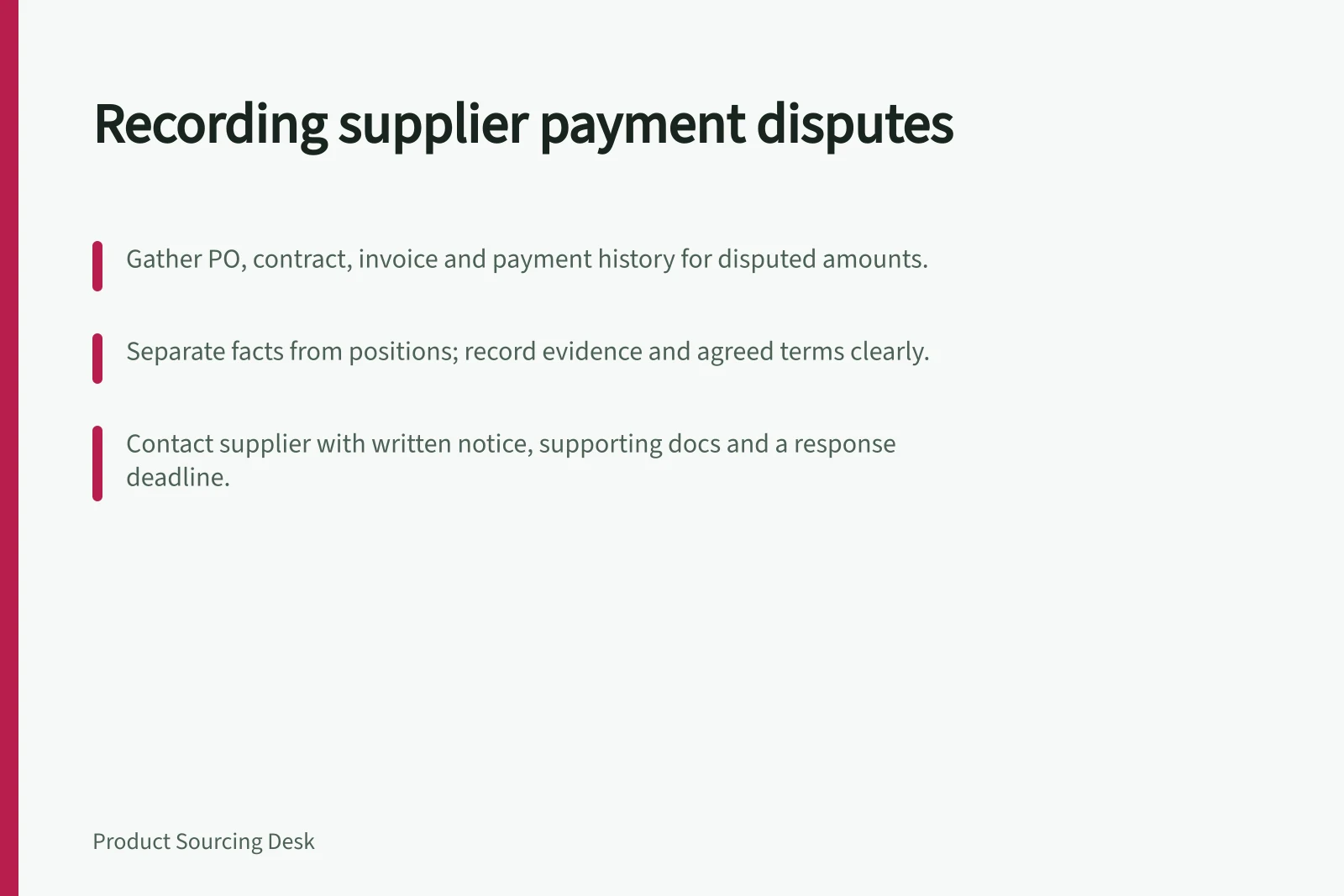
Gather the purchase order or contract, approved changes, invoice and payment history. State whether the issue concerns an unexpected charge, an early milestone invoice, a short or defective delivery, or a payment the supplier says it has not received. Give each distinct issue an amount and basis.
Field / Record
- Order and invoice
- Identifiers, versions, supplier entity and dates
- Amounts
- Invoiced, paid, disputed and undisputed amounts
- Agreed basis
- Relevant price, trigger, variation or dispute term
- Events
- Dated delivery, check, invoice and transfer events
- Evidence
- Documents and observations, with gaps marked open
- Positions
- Each party’s explanation and requested outcome
- Next step
- Contact owner and response date
Keep earlier documents when an invoice or explanation is revised. Do not record a proposed credit as though it were agreed.
Key data to record in a supplier payment dispute
- Order and invoice identifiers
- Include versions, supplier entity, and dates
- Invoiced amount
- As stated on the invoice
- Paid amount
- Amount already transferred
- Disputed amount
- Clearly defined per issue
- Agreed basis
- Price, trigger, variation, or dispute term
Explain the difference
Name the line and reason for the question. An invoice may include a variant removed by an approved change, or a progress invoice may arrive while an agreed inspection result remains open. Attach the relevant order version and ask the supplier to explain its calculation or provide the missing evidence.
Separate an observation from a contractual conclusion. “The report identifies goods for rework” describes evidence; “the balance is not due” is a position to check against the agreement. A transfer confirmation does not by itself establish receipt by the intended supplier. If changed bank details suggest fraud, contact the bank immediately and handle the incident separately from the commercial disagreement.
Evidence vs. Position: What to record separately
- Observation (fact)
- The report identifies goods for rework
- Position (interpretation)
- The balance is not due
- Observation (fact)
- A transfer confirmation was sent
- Position (interpretation)
- Receipt by the intended supplier is confirmed
Contact the supplier and close the record
Check the agreement for a notice or dispute procedure and any deadline. Contact the supplier promptly with the issue, supporting documents, desired outcome and a reasonable response date. Note any call, then confirm material points in writing. Record the supplier’s explanation fairly, including evidence that changes your initial view.
A corrected invoice, agreed credit, completed check, replacement goods or another arrangement may resolve the issue, depending on the contract and circumstances. Record the decision, approver, affected amount and supplier confirmation. Reconcile the invoice and payment record to the agreed outcome.
If direct discussion fails, consider suitable dispute support or legal advice. Australian small-business services can provide information and access to mediation, but they do not determine every supplier-payment claim. Keep the record current so the remaining issue is clear.