Freight & Payments
Part of Supplier payment risk
Keeping payment milestones tied to agreed evidence
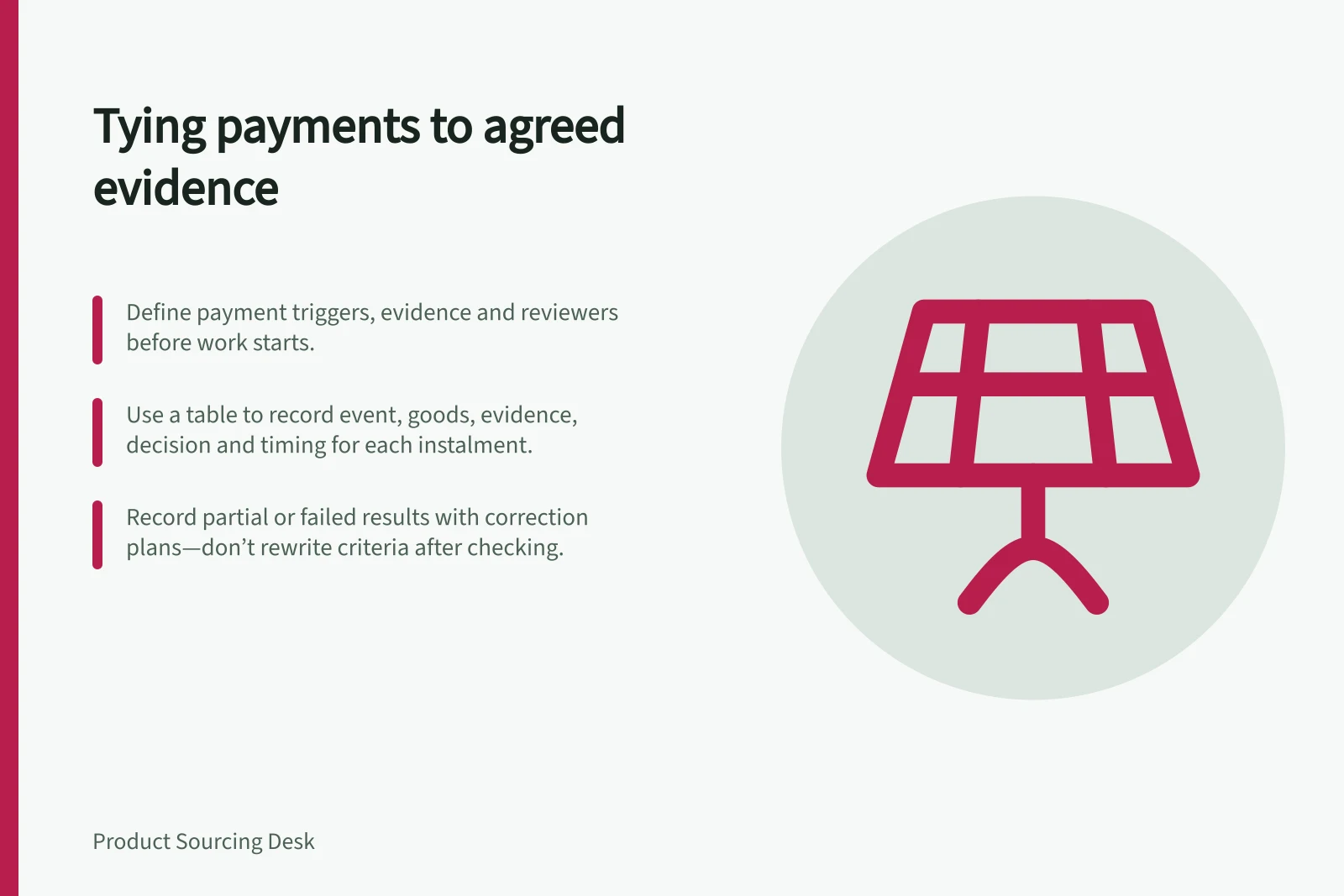
Define supplier payment milestones by covered goods, evidence, reviewer, timing and the treatment of failed or partial results.
A supplier payment milestone is useful when both parties agree what triggers it, the evidence the buyer will receive and what happens if a check fails. Set those terms before work starts. An invoice or progress update should not quietly become the acceptance rule.
Define the payment decision
For each instalment, record the order and product version, amount, covered goods, trigger, evidence, reviewer and payment deadline. Distinguish a fixed-date instalment from a result-based milestone. If payment is due regardless of production progress, describe it as a date-based obligation.
Field / Agree before production
- Event
- The production or delivery state that triggers payment
- Goods
- Order lines, variants and quantity covered
- Evidence
- The identified record, sample or inspection result to review
- Decision
- Who may accept the evidence or request correction
- Timing
- Review period, invoice point and payment deadline
- Exception
- Treatment of a failed or partial result
The agreement controls the parties’ rights and deadlines; the table records them.
Fixed-Date vs. Result-Based Payment Milestones
- Dependence on progress
- Not dependent on work completion
- Evidence requirement
- Minimal or none – payment due regardless
- Risk of dispute
- Higher if goods not delivered or defective
- Alternative: Result-based milestone
- Triggered by achievement of a specific outcome
- Evidence needed
- Agreed records, samples, or inspections
- Better for quality control
- Ensures deliverables meet agreed standards
Key Steps Before Work Starts
- Define the payment triggerAgree what event must occur to activate payment
- Confirm covered goodsList order lines, variants, and quantities
- Agree on acceptable evidenceSpecify documents, samples, or test results
- Name the reviewerIdentify who approves or rejects evidence
- Set payment deadlinesInclude review window and final due date
- Plan for failuresAgree how to handle rejected or partial results
Critical Elements of a Payment Milestone Agreement
- Must be agreed before production
- Yes
- Evidence must be verifiable
- Required
- Payment does not equal acceptance
- True – must be documented separately
- Dispute resolution process
- Mandatory in contract
Match evidence to the event
For sample approval, identify the sample, specification version, criteria assessed and open checks. For a production stage, request records showing the work completed and goods covered.
For finished goods, identify the lot and agreed checks. A photograph may show a visible feature, but it does not establish the condition of goods outside the image.
Agree any inspection, testing or correction opportunity before the instalment is due and allow time for it. If evidence cannot be available until after the due date, revise the trigger by agreement or recognise the payment as an earlier funding commitment.
Record partial and failed results
In a hypothetical two-variant order, one variant may be ready while the other is unfinished. The schedule should say whether both are required, whether an accepted quantity can trigger a proportionate payment, or whether the parties need to agree a variation. Record the quantities and decision rather than relying on “stage complete”.
If evidence fails an agreed criterion, identify the requirement and affected goods. Record the correction and recheck proposed, then whether the milestone remains open, is partly accepted under the agreed terms or is accepted with an authorised exception.
Do not rewrite the criterion after seeing the result. If payment is disputed, follow the agreement’s dispute process; seek advice before assuming that an amount may be withheld.
Keep the evidence, invoice and approval together so another person can see why a particular payment became due. Payment itself does not establish that all goods were accepted.