Supplier Shortlists
Part of Product sourcing for an Australian business
Local sourcing versus importing finished goods
Compare local supply with direct import of finished goods using total cost, timing, order size, responsibilities and Australian product requirements.
Compare local and overseas offers for the same finished product, variants and order quantity. Weigh the price and delivery time against supplier reliability, stock availability, cash commitment and the work your team must manage.
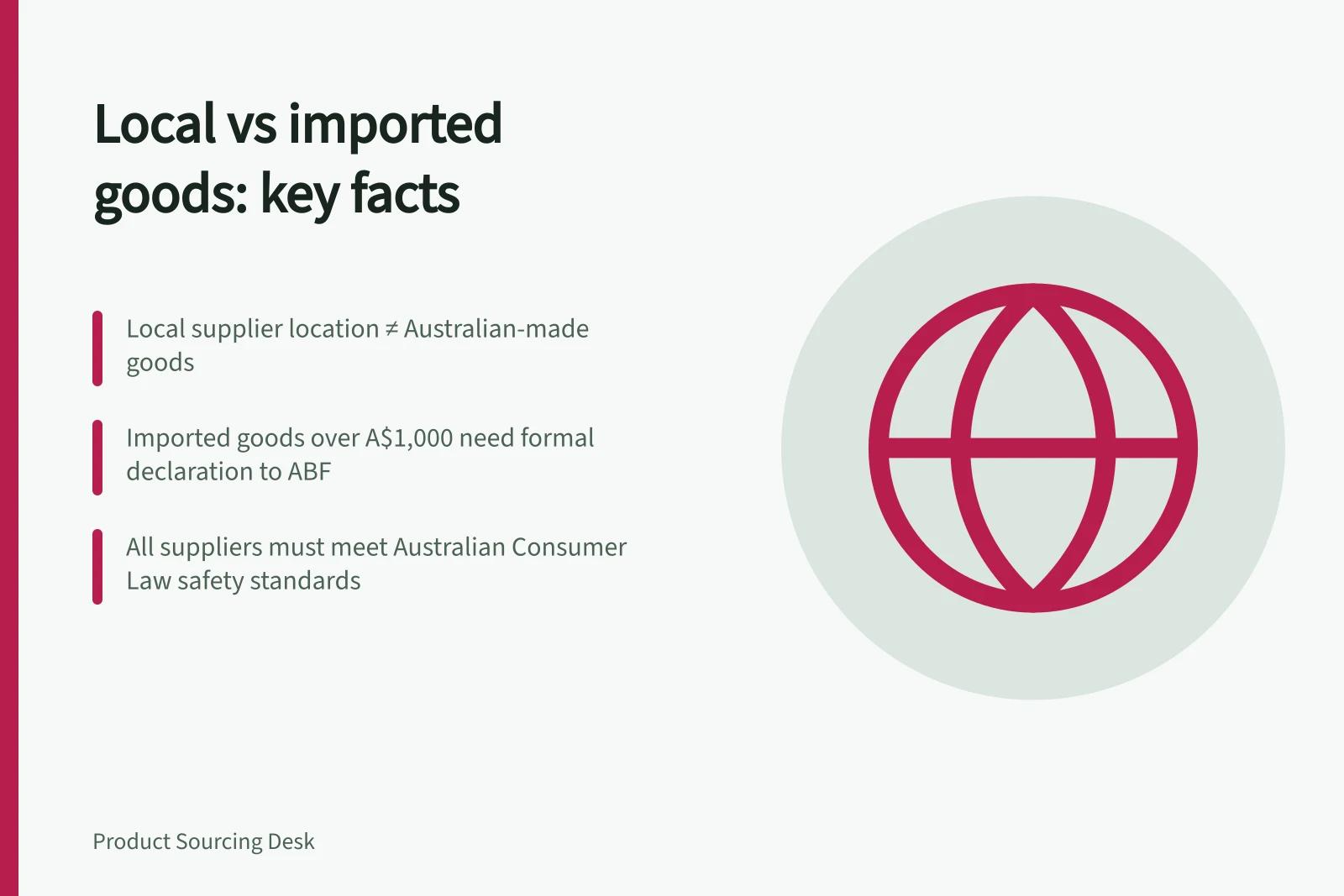
Buying from an Australian supplier does not establish where the goods were made. Treat supplier location and country of manufacture as separate facts.
Compare the work behind each offer
Ask local and overseas suppliers to quote against the same product description, variants and quantity range. Compare the delivery point, what freight and insurance are included, and who handles the remaining steps.
| Question | Buying from a local supplier | Direct import of finished goods |
|---|---|---|
| When can usable stock arrive? | Confirm available stock, replenishment time and delivery to your site. | Include production, freight, clearance and local delivery in the forecast. |
| What cash is committed? | Check the minimum order, payment date and delivery charge. | Check the minimum order, payment stages and import-related cash outlays. |
| How will defects be resolved? | Record the seller's process and agreed remedy. | Record the supplier's remedy and the cost and timing of carrying it out. |
| What must be verified? | Check the actual product, any relevant origin claim and Australian requirements. | Check the actual product, Australian requirements and import conditions. |
Treat these as questions for each offer, not guaranteed advantages of either route. A local supplier may have limited stock or a long replenishment time; an overseas supplier may offer a suitable small order. Check the terms actually offered.
Check supplier reliability as well as price. Online reviews, references and a search on the Australian Business Register can help you assess a supplier.
Local Sourcing vs Direct Import: Key Factors for Decision-Making
- When can usable stock arrive?Local: Confirm available stock, replenishment time and delivery to your site. Import: Include production, freight, clearance and local delivery in the forecast.
- What cash is committed?Local: Check minimum order, payment date and delivery charge. Import: Check minimum order, payment stages and import-related cash outlays.
- How will defects be resolved?Local: Record the seller's process and agreed remedy. Import: Record the supplier's remedy and the cost and timing of carrying it out.
- What must be verified?Local: Check the actual product, any relevant origin claim and Australian requirements. Import: Check the actual product, Australian requirements and import conditions.
Compare cost and timing on the same basis
Compare the amount payable for the same order and delivery point. For imports, allow for freight, insurance, handling, customs duty and taxes that apply; most imports are subject to 10% GST.
Most goods valued up to A$1,000 can be imported without a formal import declaration. Goods over A$1,000 generally have more complex pre-arrival reporting and import requirements.
Compare the quantity required to reach each quoted price, along with the cash and storage needed. A lower unit price may still require more cash and space than a first order can support; allow time to check goods before sale.
Keep tax cash outlays separate when comparing costs and confirm their treatment for your business with a qualified adviser.
Check Australian requirements on both paths
Australian Border Force (ABF) clears imported goods through customs when they first arrive. Unless an exception applies, goods arriving in Australia must be declared to ABF; permits and other clearance requirements, including biosecurity conditions, may also apply.
BICON identifies biosecurity import conditions for a proposed commodity, and the result depends on the actual goods.
If you supply consumer products in Australia, you are legally responsible for product safety under the Australian Consumer Law, whether you buy locally or import. The ACCC's product-safety guidance explains that mandatory standards apply to certain products; suppliers, including importers and retailers, must not supply goods that fail an applicable standard.
Ask both suppliers for evidence that matches the model and variants offered. A pre-production sample alone is generally not enough without further quality assurance; check relevant testing, factory controls and pre-shipment inspection evidence.
A local invoice, overseas certificate or visual sample is not a general approval for sale. Evidence may also be needed to substantiate claims about the country or place of origin of ingredients or components.
Key Australian Import and Compliance Requirements
- GST on imports
- 10% on most imported goods
- No formal declaration required for goods under
- A$1,000
- Biosecurity assessment tool
- BICON (online service by Agriculture Australia)
- Product safety responsibility
- Supplier (including importer or retailer) under Australian Consumer Law
Make the choice for this order
Choose the route that meets the product brief and delivery need with a manageable cash commitment and a clear owner for each remaining task. Record assumptions that could change the decision, including local stock availability, overseas production date, freight scope, required permits, test evidence and the agreed defect remedy.
Recheck the comparison if an assumption changes. A local supplier can still have limited stock or a long replenishment time, while an overseas supplier may suit a small order; decide from the offers and timing available for this order.